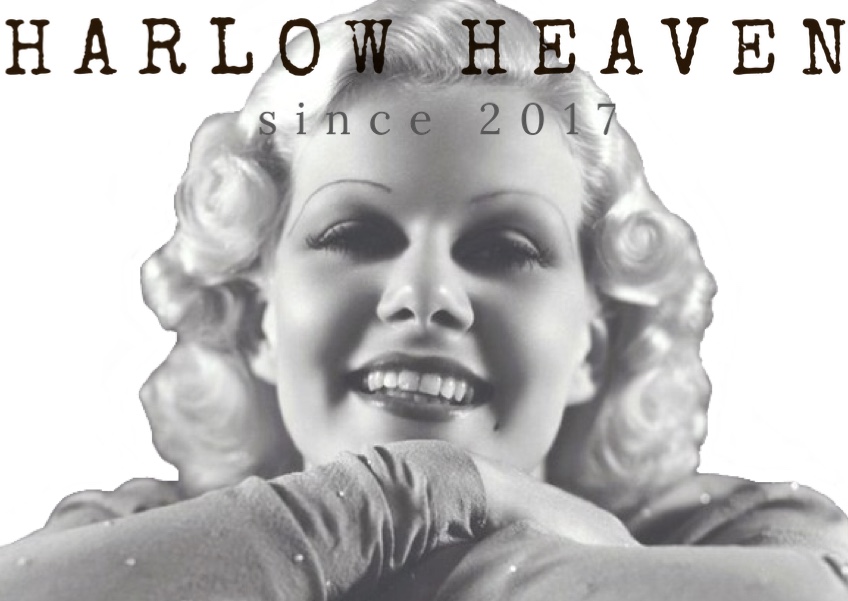
Jean Harlow, “Heroine” of “Hell’s Angels”, Worked No Three Years; Role and Girl Not to Be Confused, She Says
by Philip K. Scheuer
Not everyone concerned with the making of “Hell’s Angels” devoted three years to it. Jean Harlow, who has the principal feminine role in it–although she is not a heroine–spent only seven weeks. It came about in this way; Howard Hughes, the producer, had “shot” his aerial epic in silence, with Greta Nissen, the Scandinavian, as the girl who so nearly disrupts the fraternal affection existing between James Hall and Ben Lyon. With the decision to refilm in sound, Hughes decided against Miss Nissen’s continuing in the role, and began casting about for some one else. Miss Nissen, meanwhile, dropped quietly from the reigning ranks of Hollywood, went East and took up vocal training in an obscure stock company somewhere near New York.
Mr. Hughes found his work cut out for him. He made, he says, more than 100 tests before he resolved upon whitish, flaxen-haired Jean Harlow, a virtual unknown, for the part. Miss Harlow was, of course, surprised and delighted. She took up rehearsals almost immediately with James Whale, who, fresh from the staging of “Journey’s End” wherever theaters prospered, was in the movie city to transpose it to the screen. While waiting for Tiffany to get ready for “Journey’s End”, he trotted over to Mr. Hughes’s place to rehearse the talk for “Hell’s Angels”.
“I never saw the rushes,” said Miss Harlow, a statement corroborated by each member of the cast regarding his or her own case, “Until the premiere, I had never even heard my voice. It sounded, on the opening night, too fast. I wondered about my articulation; I worried. It seems, though, that it wasn’t I, but the man in the projection room, who did things to my voice. I’m relieved.”
Miss Harlow, consciously attractive but apparently far removed from the calculatingly lascivious trouble-maker of the picture, is at present experiencing a dread familiar to many of those who have seen their names spun electrically from marquees for the first time. She is fearful that her initial opportunity to be somebody in the mad movies will cause fans to confuse the role with the girl; or, worse yet, that those odd fellows, the directors, will list her under “types” as “trollop” forevermore.
“The girl in the picture,” she explains, “is really not a prototype of anybody at all. I think she is supposed to have had some kind of respectable upbringing–the environment in which she at first appears might point that way–but you can hardly tell it, to judge by her carryings-on later!”
The “carryings-on” referred to by the young lady are, as those who have witnessed the film will testify, largely the photographed whim of an adolescent who, possibly gazing through disillusioned eyes at a thankless world, sought to paint the fair sex as ever so much less than that. No woman gets an even break in “Hell’s Angels”, that privilege is reserved solely for airplanes and Zeppelins. Hence Miss Harlow’s plaint.
“But I am, nonetheless, grateful to Mr. Hughes,” she says, “I am still under contract to him, and he has signified his intention of treating me more kindly next time.”
Until then, Jean Harlow, a mere 19, can afford to rest on such laurels as come her way from “Hell’s Angels” as it travels the world. Of glory, there is enough to go ’round.

