Riffraff (1936) was my first Jean Harlow movie. Strange that a mediocre box office bomb started my love for her. Most fans start off with Hell’s Angels (1930), which created Harlow, or one of her 1932 MGM blockbusters; not in my case.
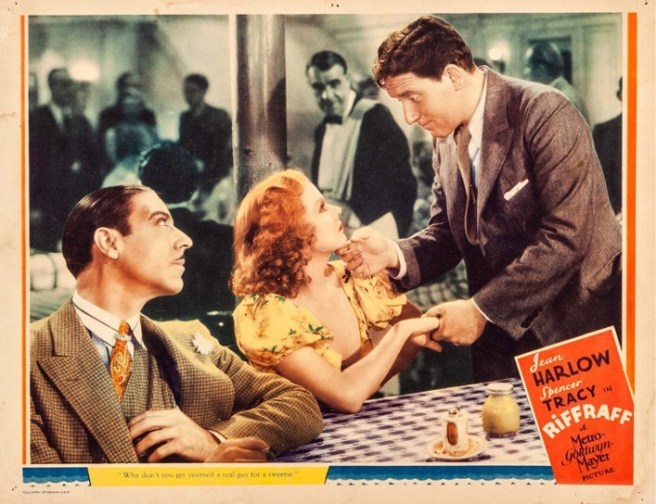
I can’t recall how that came to be, but I remember being absolutely stunned by the brownette Jean in this film and the combination of qualities she exuded. Brassy, but with a heart of gold (pun intended); tough but dainty at the same time. And just about the only likable character.
The movie takes place in a blustery port town not unlike San Francisco. Our main characters, Harriet “Hattie” Tuttle and Dutch Muller, work at Sea Queen Tuna Packing Company; Hattie works in the cannery, and Dutch is a fisherman. They’re played by Jean and Spencer Tracy, respectively.
Hattie lives with her father, sister, brother, and her sister’s two children in a dingy shack by the waterfront. She uses the wages from her cannery job to support her struggling family. Dutch is a shameless, ungentlemanly, and extremely brash man, but Hattie’s head over heels for him. He keeps her on a string to bolster his ego, and the two spar throughout the film due to his poor treatment of her. Many scenes include Hattie simply begging and chasing after Dutch like a lost puppy.
However, she initially downplays her interest; Dutch isn’t serious about her, he’s keeping other women, and he isn’t too popular. Breaking up a union strike on the wharf held by your coworkers doesn’t get you many friends. Dutch starts a brawl among the strikers and only narrowly avoids getting arrested when Hattie creates a diversion. A newsreel begins interviewing Dutch, and as Hattie runs up, he takes a hand to her face and pushes her down. She retaliates by chucking a fish which knocks him into the bay; the newsreel catches it, and Dutch becomes the laughing stock of the cannery.
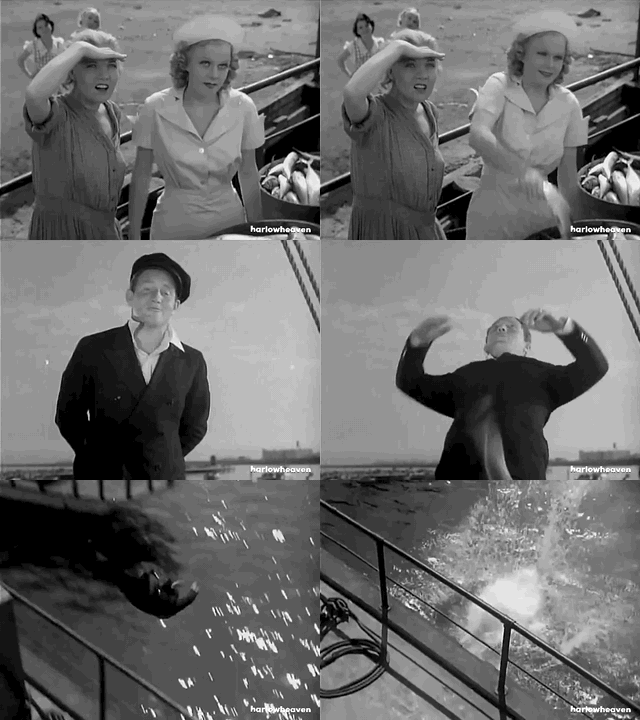 Watch out, Dutch!
After being spurned, an opportunity arises for Hattie to get on with the boss of Sea Queen Packing Company, Nick Lewis. He has the hots for her and although she’s not interested, she keeps him on a string in the same way Dutch did; even accepting a fur piece without any intention of another date.
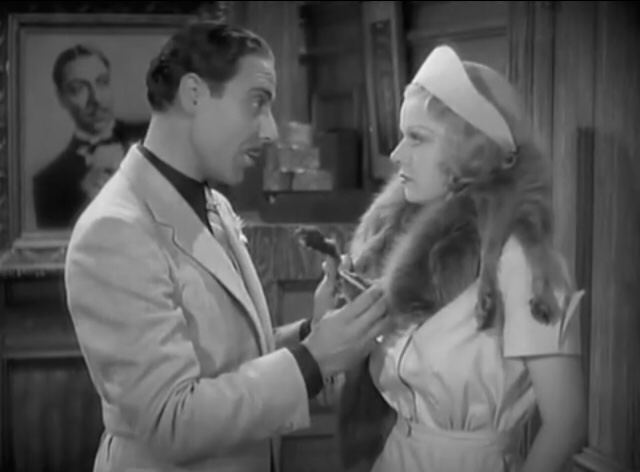
Suddenly deprived of Hattie’s attention, Dutch is furious! Not able to take seeing it showered upon his boss, he decides to make a complete turnaround and take a stand with his coworkers in the union. All so he could get Hattie after him again to continue ignoring her. At this point it makes sense why the film is called Riffraff: it was an insult used to describe Dutch’s lowly character and lack of money.
However, Hattie and Dutch end up back together soon enough and married. Unable to afford anything, Dutch furnishes their new home on credit and ends up with everything repossessed.
The situation continues to escalate. Unsurprisingly, Dutch’s self-serving behavior gets him sacked from the union and from his job. Defeated, he trudges off to a hobo camp in Sacramento and leaves his wife behind.
You’d think all this would have Hattie put off from Dutch forever, but not even close. She steals money from her boss under the pretense of romance, and goes after Dutch to give it to him. Before you could finish saying “What?” Hattie is caught in the crime and sent to the fictional Soreno Valley Women’s Prison.
Hattie gives birth to Dutch’s child in prison, and the baby is taken in by her sister Lil (Una Merkel). He gets a new job so he can afford to put Hattie on parole, but she ends up escaping through a sewage tunnel under cover of rain and darkness. Dutch is welcomed back to the union and considered a hero after he stops a few wayward members from bombing the wharf.
After some further difficulties, Hattie and Dutch finally reunite. An eavesdropping policeman is convinced of their true love and uses that as a reason not to take Hattie back to prison. Realistic, right? Happily ever after.
The plot of Riffraff might be lackluster, but the story of its production isn’t.
The Production Code had its beady eyes set firmly on Harlow in 1934-35. Her sexy, swaying figure and luminous hair hadn’t been eradicated from films yet, and the Production Code Administration was on a mission to tone her down. Combined with this, Harlow had been suffering from hair loss due to years of overbleaching. The production of RECKLESS (1935) was concerned with hiding Jean’s thinning hair onscreen (a wiglet, braided into an updo, was used). By the time she began filming CHINA SEAS (1935) in March of that year, she had been fitted with a full platinum wig.
One solution solved both of these problems: changing her hair.
While her short, brittle hair grew out underneath, Jean had a series of different brown wigs created for her in fall 1935. Since the hue was not quite brunette or blonde, it was dubbed “brownette”. And with that, the platinum blonde was gone; so was her catty screen image. Additionally, the less flashy Dolly Tree replaced the glamorous Gilbert Adrian as Jean’s primary designer. George Hurrell was tasked with taking promotional images of the new Harlow while Riffraff started production.
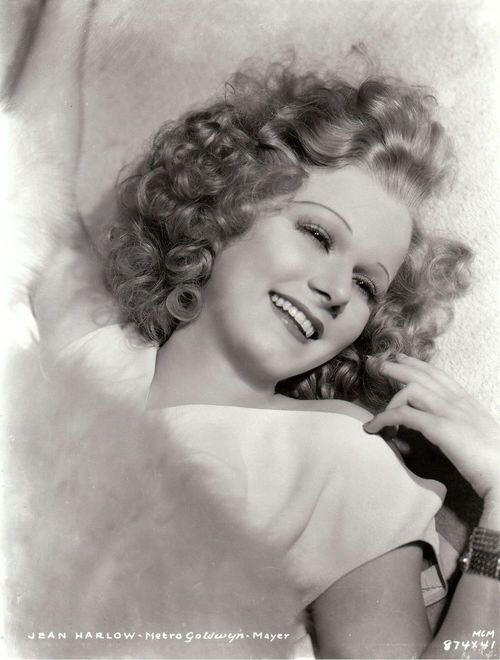
Using wigs for the entire production, Jean filmed Riffraff in August through October 1935 on location at Venice Beach. It was released on the third of January the next year. As a result, people differ on which year the film is really from. I say 1936 simply because that’s when the film was released, even if it was only 72 hours in.
The initial production was not without its problems. According to Harlow In Hollywood by Darrell Rooney and Mark A. Vieira, producer Irving Thalberg had a little argument with his contemporaries over the film. Thalberg had hired director Tay Garnett to oversee the film; Garnett up and left the project after he was convinced putting Harlow in the film would ruin her career. “Harlow is the most famous courtesan in the world,” said Garnett, “People know her as a lovable tramp. Now you’re trying to put her in the role of a Madonna.” Garnett was replaced with J. Walter Ruben and production resumed.
In Bombshell: The Life And Death Of Jean Harlow by David Stenn, the author reveals a memory from makeup artist Layne Britton. Spencer Tracy, an alcoholic, had taken such a dive that it delayed filming for ten days. When Tracy showed up drunk on the set again, Harlow promptly left. Britton followed and asked what the problem was. “Tracy’s gassed,” she responded, “and I’m not going to work ’til he gets straightened out.”
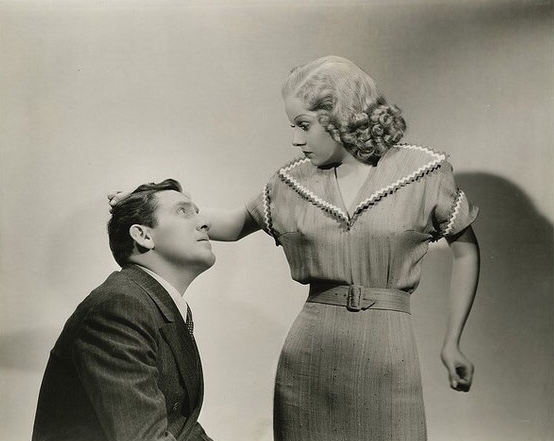
Since Harlow was never one to be confrontational, Tracy took her seriously and stayed sober for the rest of Riffraff. They were great friends off the set, a far cry from their behavior in the film. It was their first appearance together since the scandalous Fox production Goldie (1931) and they would be paired again immediately for Libeled Lady (1936). George Hurrell noticed their friendship while he was posing the two for promotional photos. “When I shot them together and he drew her close, there was a tenderness expressed that was very touching,” he recalled.
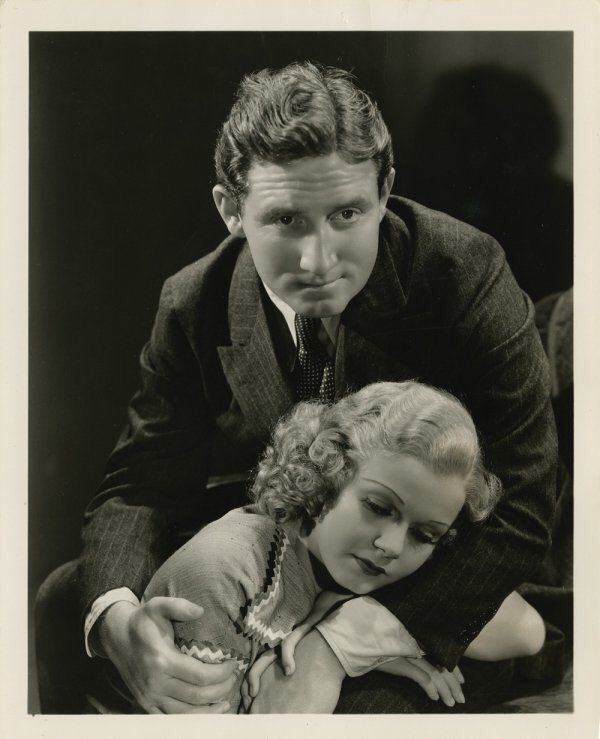
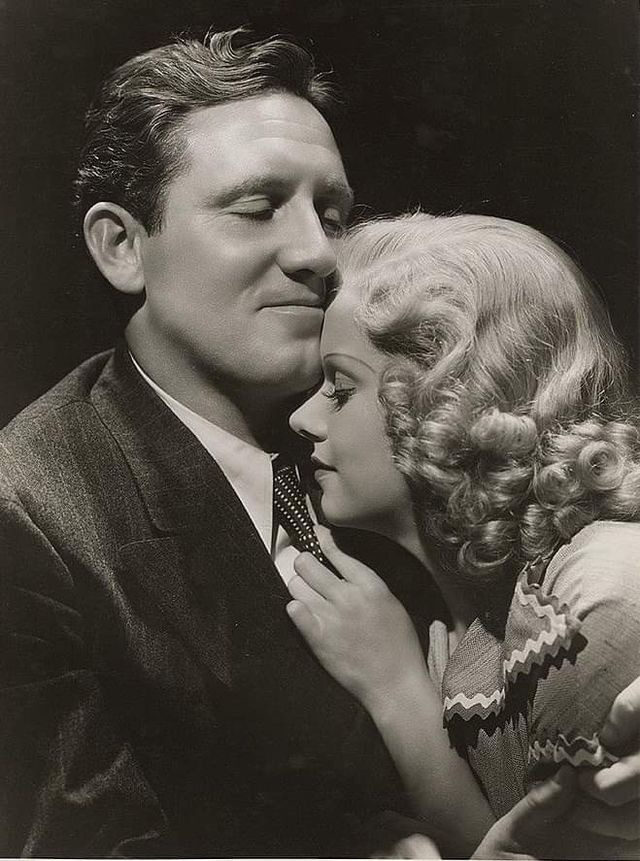
Riffraff was not executed very well, especially when it was supposed to reintroduce Jean Harlow to the public. The plot has obvious holes, the characters are unlikable, and it frankly smells quite fishy. Jean’s performance overshadowed those of everyone else. MGM spent over a million dollars on the film and made no profit. Losses are given as anywhere from $63,000 to $103,000, according to different sources. (Harlow in Hollywood gives the second figure; The Eddie Mannix Ledger cites the first figure).
Nonetheless, the box office bomb had no effect on Jean’s allure and her new appearance proved very popular. She went on to make hits such as Wife vs. Secretary and Libeled Lady which were filmed consecutively in fall 1935 and early 1936. Considering Jean was pumping out four films a year, it makes sense one would be a dud. That dud is Riffraff.
Despite the vox populi condemning Riffraff as horrible, it really isn’t. It definitely lacks, and there are structural failures in the film, but they don’t immediately cancel out the good qualities. Joseph Calleia does a brilliant job as Nick Lewis, and a young Mickey Rooney adds a touch of screwball comedy to otherwise boring scenes.
The film tackles poverty and trade unionism in an era where these issues were important to the public. The scene of Hattie traveling to the Sacramento hobo camp to find Dutch evokes a certain kind of pathos for the Depression-era viewers who undoubtedly experienced the same in Hoovervilles. This may be part of the reason the film flopped; people came to the movies to escape their problems, not see them relived.
Riffraff at its core does not hold a candle to Jean’s other, better films, but it holds a special place in my heart. It introduced me to the talent of one of my favorite people, Jean Harlow. It may not be a goofy precode or a lush late thirties success like The Women, but Riffraff has its own personality that makes it worth the watch.
Citations and Sources
Rooney, D., & Vieira, M. A. (2011). Harlow In Hollywood: The Blonde Bombshell in the Glamour Capital, 1928-1937. Angel City Press.
Stenn, D. (1993). Bombshell: The Life and Death of Jean Harlow(1st ed.). Doubleday.
The Eddie Mannix Ledger, Los Angeles: Margaret Herrick Library, Center for Motion Picture Study.


Very interesting read…Thank you 😊
LikeLike
Loved your article on Jean Harlow and the movie 🎬 “Riffraff” 💓… and I always thought it was a box office bomb because nobody wanted to see poverty on the Silver screen just after the market crashed and still feeling the effects of the great depression 🫥 otherwise it was a good flick.
LikeLike
Very nice summary – keep up the good work.
LikeLike
I love Jean Harlow’s role. She illuminates the film. Delightful.
LikeLike
As always, Jean Harlow shines in this film. A true star. There’s always something honest and sincere about her portrayals and she’s always able to capture the nuance of her characters.
This movie is definitely better than its perception through the lens of time. It deals with some unique aspects of life , love and character development.
Dutch is a fascinating character portrayal, going from brash conceit to humble humility. A man who has his sharp edges and fire dulled by the realities of life’s harshness and obstacles. There aren’t many stories that deal with this reality. It is done with a simple exposition.
There were so many unique and touching relationships throughout the film. Brain and Dutch was a beautiful one. A true and genuine friendship and love between men.
Ultimately, it’s a touching story of redemption and even the had edged policeman is ultimately drawn into that tide and shows heart behind his crusty demeanor.
Definitely, a movie that stays with you.
LikeLike