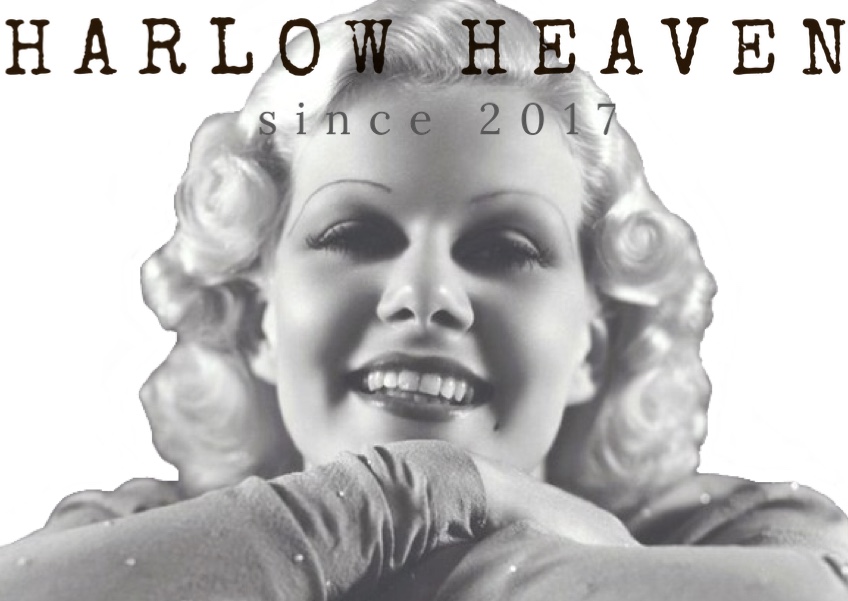
Starting off, it’s fairly well known that Jean was a voracious reader and writer from childhood. She tended to write long and wordy personal letters; she even penned a poem titled “I Have Found God” at the tender age of ten. Multiple times over the years in different interviews, she expressed her love for writing and implied she would rather have been an author. She comes off frightfully unsure of herself, however, and it’s unfortunate.
“Tell us about your ambition to write — is it true that you are writing a novel?” was asked of Jean by reporter Eric L. Ergenbright during an interview for Motion Picture, 1933.
“I wish it were true. As yet I write only for my own pleasure. Maybe someday . . . ” Jean responded, her disappointment palpable through print. Understandably, it was hard to be taken seriously as a writer when you were already one of the foremost film actresses. That novel did come to fruition, however; Jean wrote the bulk of Today is Tonight during her 1933-4 suspension from MGM, and was already fiddling with it when she denied writing a novel in the interview above.
Today is Tonight was completed long before Jean’s passing with the guidance of her close friend, screenwriter Carey Wilson. The manuscript has passed over many hurdles to get where it is today. Its racy content, among other things, mirrored Jean’s personal life a little too intimately for MGM’s taste. Jean’s stepfather, Marino Bello, had caught wind of the novel as well and immediately publicized it to anyone who would listen. Considering Jean was still on suspension from her home studio, Bello decided to pitch the novel everywhere else… which was against his stepdaughter’s contract. Bello successfully ignited the fiery temper of L.B. Mayer with his scummy move, and Today is Tonight was repressed in return.
It was only after Jean’s mother died in 1958 that the novel’s rights passed to her good friend, Ruth Hamp. The wife of bandleader Johnny Hamp, Ruth did us a big favor and moved to have the manuscript published. Today is Tonight finally entered circulation in 1965. “Explosive, long-suppressed novel!” covers screamed.
We know that Jean experimented with other forms of prose during her suspension, which she talks about in a December 1935 interview for the Oakland Tribune. She told columnist Grace Wilcox she had written a grand total of two novels, twelve short stories, and several articles.
“Most of them I can show you; some of them I have burned,” Jean answered her interviewer honestly when asked where her writing was kept, “I can prove that I haven’t had a ghostwriter, or that the story of my writing has not been a publicity stunt. If you want to read them, I’ve got them all neatly typed.”
One of these neatly typed short stories that escaped banishment to the fireplace was Extra Girl Gets Her First Close-Up. In 1935, just weeks before this interview, famed social impresario Billy Wilkerson got his hands on the story and included it in the September 1935 anniversary edition of his publication, The Hollywood Reporter. Inevitably, gossip ensued.
“Could it be a true story taken from her own experiences?” bylines asked, though the answer was obvious from the text. Jean brings up the swiping of and printing of her story in the aforementioned Oakland Tribune interview:
“For several weeks now I haven’t been writing, but not long ago when Mr. Wilkerson was getting out his anniversary edition of the Hollywood Reporter he got hold of a manuscript of mine from Carey Wilson and printed it. It is a short story of an extra girl and the whole town has been ragging the life out of me about it. I have been embarrassed, chagrined, and amused. If I say it is mine, they tell me I’m a pretty fair actress; if I say, with a shrug, that it is just one of those things, they ask where they can find my ghost writer. So there you are. As a writer, any way you look at it, Jean Harlow is a perfect flop.”
“But is she?” empathized interviewer Grace Wilcox, who referred to her story as “an amazingly brittle little satire, something on the order of those done for smart magazines by the French novelist Colette.”
I agree with Wilcox. But for now, let’s set aside everyone’s opinions on Jean’s prose and let it speak for itself. The woman lived and died letting others speak over her. Let’s let her have a moment. Here’s her own story as it appeared in print from The Hollywood Reporter.
Extra Girl Gets Her First Close-Up
Suppose — oh, just suppose, it doesn’t cost anything — suppose she should get a close-up today!
The thought warmed her. She had summoned it into mental existence many hundreds of times, just for the sake of that warming tingle which came in its wake. After all, it wasn’t impossible! It does happen to extra girls — well, not regularly but frequently enough to justify the perennial visualization of its glorious possibility.
She thought about herself, very carefully. She surveyed her whole person, in critical analysis as if she were someone else, just as she had actually and meticulously studied herself that morning in the bleary mirror of her bathroom door — a smooth white body, unflawed, taut with youth, curved with promise, clean with hope.
She found nothing much to criticize — except that she did not have artificial eyelashes.
She tried to compensate herself with the assurance that at least her eyebrows conformed to the Hollywood convention. Of course it had been something of an effort to shave the brows cleanly off this morning, and to pencil the thin, highly-arched arcs of unreality in place of the silky ash-blond hairs. She had postponed this for almost a year. It did not, however, give the complete effect. She must have the artificial lashes. Her own lashes upper and lower, were adequate — even abundant — but they were real and hence marked her as one of the rank and file.
She had stopped wearing stockings six months ago. Stockings cost too much, but more important was the reason that bare legs may not be classified so readily as stockinged ones and she was conscious that the curves of her calves were vaguely irregular.
Her mouth was her strong point. Mouth — which means, on only visual contact — lips. She had made her lips important by long hours of study in the mirror. The carmine lipstick now outlined the upper lip in a sweeping single curve so brutally false as to provoke a second and interested glance; it was a cheap lipstick; she had found it in a boulevard drugstore; but it made provoking the wet smear of lambent color.
For seven weeks she had planned to buy the artificial eyelashes. It was not a tragic necessity for food and shelter which weekly devoured the eyelash appropriation. It was the thousand and one other little things even more important to an extra girl.
Shoes. Assistant directors always look at your feet first.
Hair. No matter how simple a coiffure you evolve, the beauty shop cannot be dodged forever.
Makeup. You’ll never get a close-up unless your makeup is satin smooth with the very best grease and powder and shadings.
Telephone calls. Not only the daily routine to Central Casting, but the three or four calls every day to Marcella or Red or Tommy, the several various persons in different studios who had manifested a degree of friendliness sufficient to warrant a call reminding them of your existence.
Hats. You can’t fake hats the way you can fake clothes. Hats change — irrevocably.
Transportation. The cruelest burden of all the burdens. First National, way over in the valley. Metro, far out in Culver City. Fox, in Westwood. Funny the way Easterners came out here and expected to find all the studios cuddled up in one handy group in the heart of Hollywood. Hollywood? Hollywood isn’t a city. Hollywood isn’t even a district. Hollywood is the name of an idea, and its ramifications stretch expensively far and wide for the extra girl. Her nose wrinkled delicately with the shadow of an impish grin — maybe she’d waive her spirit of independence long enough to accept that “hundred and a quarter” from Daddy and buy a secondhand Ford — maybe she wouldn’t, either.
Even without the artificial eyebrows she knew she looked “hot” today. There were only, she counted, twenty girls on the set. She knew very well that at least twelve of them had been selected from the Assistant Director’s list. The other eight had come direct from Central Casting.
That’s funny too, and she remembered what that nice woman at Central Casting had told her. How the real problem was not only finding work for extras but finding the right extras for the work. How few really lovely well-dressed girls had she said were available?
She relaxed with satisfaction. Yes, she was undoubtedly the best-looking, best-dressed, best made-up extra on the set. And that without counting her hair. Her hair would get her a break some day, she felt sure. Its pale ashen loveliness was natural. She liked to announce the fact somewhat arrogantly to the bleached sisters.
As a matter of fact, it was not her hair which attracted the Assistant Director. His roving eye flickered about and settled on her because she was the one girl in the lot that he had not quite classified. He had actually nothing on her. He’d heard rumors, but rumors are nothing in Hollywood. His wife — who had secretly “worked extra” under an assumed name — had sniffed quite vigorously one night at “that blond dame” with her twenty-two dollar Fifth Avenue shoes. Still, he could comfort himself on his selection of her with the reassurance that she was really the most striking girl of all the twenty.
“You,” he said to her curtly, “be ready for a close-up at three o’clock.”
She looked at him dully, not quite segregating his actuality from the endlessly dreamed visions of this moment. Then she knew it was reality, because his eyes lingered on her for a second. His gaze was not lascivious nor acquisitive. It was kindly and gracious.
In a sudden warm flash of understanding she realized that Assistant Directors are human, probably dine on meat and vegetables rather than fire and brimstone, and even possibly might have been born through the ordinary human processes of life.
The Director was rehearsing a dialogue two-shot. From experience she knew the leading man would not acquire the proper emphasis for at least another hour. She walked proudly off the set with the sure knowledge that she was entitled to some time for preparation. She was going to have a close-up.
The kindly hairdresser responded nobly. The ash-blond hair was done and re-done and done again. The make-up was removed and put on anew with loving care and trembling hands.
If she only had those artificial eyelashes! Why hadn’t she yielded to temptation this morning — why hadn’t she turned her steps into that drugstore?
Now there is a God, even in Hollywood.
It was certainly one of His minions, this slim southern girl “in stock,” who overheard the lament and proffered — a pair of artificial eyelashes for the great event.
“Hop to it, kid,” were her words.
“Your first close-up may get you plenty. You’re telling me! And what’s a buck to me? I’m in stock! Of course nobody but His Nibs … and the Cashier, and Allah il Allah to him … knows I’m in stock, but I’ve been collecting that little check every Wednesday for five months. Here — good luck –”
They were ready and waiting when she came back to the set. It was more important than an outsider would think. They would make several takes of that close-up, and the Producer himself — to say nothing of his staff and secretaries and the Director and maybe even the Head Man who sat in his “mahogany hell” of an office — would be interested in that day’s rushes and thus forced to look full into this lovely face of hers for several minutes.
With an approving nod the Assistant Director took her firmly by the arm and led her to a spot about which dazzling lights were concentrated. Her heart was bursting within her.
“Sit there on the arm of the couch,” the Director himself was speaking.
“Pull up your skirts, way up — above your knees!”
Then she understood. They were going to take a close-up of her LEGS.
Sources
Ergenbright, E. L. (1933, July). “Jean Harlow Answers Your Questions”. Motion Picture.
Harlow, J. (1935, September). “Extra Girl Gets Her First Close-Up”. The Hollywood Reporter.
“Jean Harlow Wrote This Short Story About an Extra Girl”. (1935, November 3). The Des Moines Register, p. 58.
Stenn, D. (1993). Bombshell: The Life and Death of Jean Harlow(1st ed.). Doubleday.
Wilcox, G. (1935, December 8). “Harlow’s Woes as an Author”. Oakland Tribune, p. 73.

