Introduction
False quotes have been attributed to popular public figures practically since the dawn of time; Jean Harlow is no exception. Harlow, like countless other sex symbols of all eras, had already suffered through being squarely pigeonholed into a scandalous image by a public thirsty for outrage and scandal. Her untimely death started a decades-long game of telephone, and made ample room for seedy figures to fabricate sensational lies–Harlow’s particular abundance of misquotations can, for the most part, be directly attributed to the proliferation of Irving Shulman’s 1964 sleazy Harlow “bio”.
Shulman’s trashy tell-all “Harlow: An Intimate Biography” (which can hardly be called such) was the result of a collaboration with Harlow’s one-time agent, Arthur Landau. Landau had befriended Harlow during the production of her early two-reeler Weak But Willing (1929), and went on to manage her throughout the Hell’s Angels (1930) era; he was effectively dismissed as manager by Harlow’s mother late that year when, strapped for cash, she decided to handle her daughter’s affairs herself (Stenn 1993, pg. 52).
Landau remained relatively close to Harlow and her family for the rest of her life, but his knowledge was overstated; correspondence was almost exclusively with Marino and Jean Bello. Nonetheless, Landau went on to make grandiose claims about his time working with Harlow, and maintained that his guidance had landed her the lead in Hell’s Angels (something that was actually done by Harlow’s co-star, James Hall.) (Stenn 1993, pg. 37).
Parade columnist Lloyd Shearer gives us a peek into the circumstances that brought Landau to Irving Shulman; by the fifties, he was well past middle age and had developed laryngeal cancer–treating it meant the disappearance of his life savings (Shearer 1964, pg. 6). By the time the early sixties rolled around, nostalgia for Harlow’s era was rife, and Landau must have known he stood to make a buck; he got in touch with Bantam Books editor Saul David, who by then was working at Columbia. Recognizing the value that came with Landau’s memories of old Hollywood, Saul thought they would make an “interesting best-seller” (Shearer 1964, pg. 6), so he contacted Irving Shulman and infamously publicity-driven publisher Bernard J. Geis, striking a deal with the latter for a Jean Harlow biography.
Landau and Shulman’s correspondence, much like with Harlow’s mother and stepfather, was largely done through letters; this turned into Shulman scavenging tidbits from Landau’s written memories and embellishing them, transforming them into sordid half-truths. Harlow’s personality was reduced to a licentious harpy whose promiscuity and foul mouth emasculated Paul Bern and culminated in his suicide; Jean’s mother, however questionable her character, was unfairly persecuted as a devout Christian Scientist who shut her daughter away from medical help and hastened her death.
The book was widely panned by colleagues and critics alike–it’s worth mentioning that Harlow’s father sued for $3 million–and Irving Shulman alluded to his blatant deception by saying “the line between biographical fiction and fictional biography is fine indeed,” (Stenn 1993, pg. 246). Despite this, sex sells, and the Harlow craze was such that two separate film versions were made in 1965 with the same title; one from Paramount starring Carroll Baker, and a low-budget Electronovision version released through Magna, which starred Carol Lynley and a declining Ginger Rogers as “Mama Jean” in what would ultimately be her final film role.
As a consequence, “Harlow: An Intimate Biography” is firmly ingrained in pop culture, and its assertions took decades to be properly questioned; though most of Shulman’s falsehoods have now been thoroughly exposed and debunked, the saucy quips he attributed to Harlow stubbornly remain and are some of her most widely shared “quotes”. In one chapter, Shulman inserts a salacious fake Q&A into a scene involving one of Harlow’s personal appearances; a reporter asks why she thinks audiences like her, and she replies “The men like me because I don’t wear a brassiere. And the women like me because I don’t look like a girl who would steal a husband. At least not for long.” (Shulman 1964, pg. 103).
This and related excerpts are easily Googled and found pasted onto Harlow’s glamour shots, taken at face value as things she really said and believed; here are a few other examples of false quotations from “Harlow: An Intimate Biography” that make the rounds:
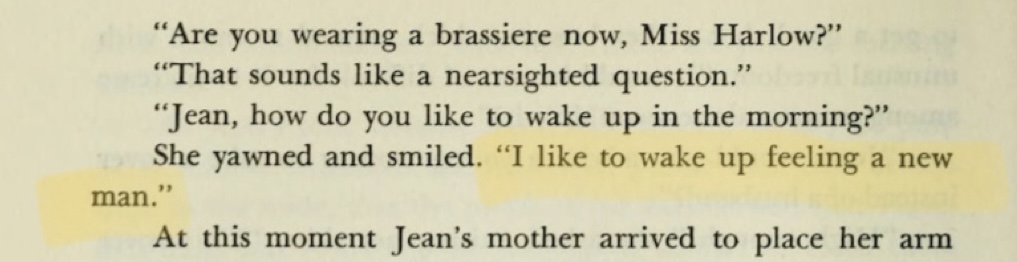
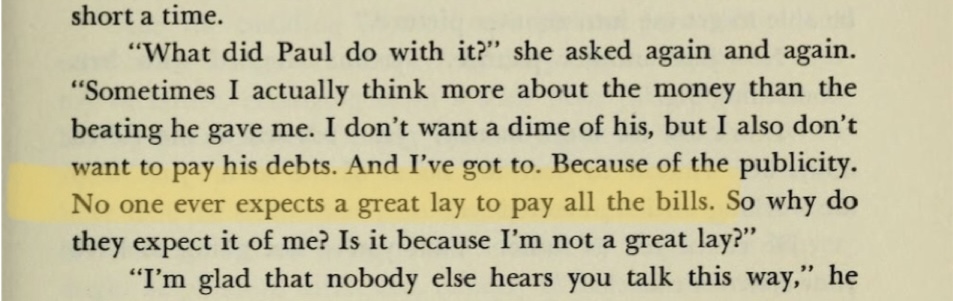
It’s almost sinful that so many of these Irving Shulman fabrications are accepted as fact when Jean was wonderfully witty in her own right, and left us with plenty of quotations to choose from that don’t paint her in the same light that Shulman did. Though this is far from a comprehensive list, I’ve collected a few of Harlow’s more memorable quotes and put them in chronological order. Hopefully, these will be shared a little more widely than the “Harlow” excerpts, and perhaps lend Jean Harlow a little more humanity–to be unfairly flattened into a one-note caricature of yourself in life is one thing, but for the gag to be continued and exploited eighty-five years after death is another.
Authentic Jean Harlow Quotes:
“I want a mode of expression. I have a highly nervous temperament. The only way I can lose myself, take my mind off myself, off everything, is to have one. I am never really happy except when I am working. Of course I think all of us, unless we have something to do, grow a bit mad.” — Harlow to Courtney Allison. From “This Is A Sad Life, This Film Biz For Jean Harlow, Blondly Lovely”, Variety, September 3, 1930.
“While working in Hell’s Angels many people commented on the color of my hair–or rather its lack of color–and after the picture was released I received hundreds of letters asking me how my hair had become so white. When I found the question in almost every fan letter I realized that I had started a fad.” — Harlow in The Baltimore Sun (article unsigned), August 9, 1931.
“There are just two kinds of men [..] Those that play golf, and those that don’t.” — Harlow to Jessie Henderson, from “Jean Harlow Big Surprise In Hollywood”, The Ogden Standard Examiner, August 16, 1931.
“Friendship is the finest thing in life. I should think that if the man a girl married were first of all her friend, she would have ten times greater chance at making a success of matrimony. I like thoughtfulness, consideration and loyalty, all the best qualities of the best of friends. Friends give you freedom. They don’t try to restrict your thoughts or your actions. They are tolerant and sincere and they take you as you are.” — Harlow to Alice L. Tildesley, from “Friendship The Finest Thing In Life Says Jean Harlow”, October 1931.
“I’ve decided I’m going to be an actress, not a professional sex-vulture. If I don’t, I’ll get a job as a clothes model.” — Harlow to Ruth Leiber, from “But I Can Unmask Jean Harlow”, Photoplay Magazine, November 1931.
“They seemed to have ‘typed’ me as the sophisticated menace out in Hollywood. Well, anyhow, it’s something for Kansas City, Kansas, to produce a menace.” — Harlow to the Kansas City Times (article unsigned), December 8, 1931.
“After “Hell’s Angels”, I worried a great deal about having to play such obnoxious characters. But I don’t believe they hurt me much. I answered every letter from a movie fan. I was always careful to let them know I wasn’t a platinum-haired husband-snatcher in real life. This began building up a terrific correspondence. The funny part of it is that I get about fifty letters from women to one from a man. They all seem for me. I think women like vampires more than men do. It hurts men’s vanity to see a woman make a monkey out of the men characters in a story. It gives women a thrill to think their sex can outsmart the big bare-knuckled he-men.” — Harlow to the Kansas City Times (article unsigned), December 8, 1931.
(About seeing herself in Red-Headed Woman) “I was scared to death, but halfway through the picture I started to laugh at myself. I was such a horrid, scheming little small-town girl, so obvious, so ruthlessly deliberate in my tactics. For the first time since I have appeared in pictures, I really enjoyed looking at myself. And I didn’t have any particular feeling that it was I. In fact, I enjoyed the whole picture.” — Harlow to Muriel Babcock, from “Redhead’s Life Exciting Whirl”, Los Angeles Times, June 26, 1932.
“The public likes me that way, and even in these depressed times is willing to pay to see me doing that sort of role. I’m sort of an Eternal Other Woman, I guess—at any rate I’m enough of a novelty to have established a vogue. And as long as it’s popular—why, what else is there to do but continue to exploit it? Of course, there is the inevitable penalty. Too often the kind of people I like are suspicious of me and aren’t as kind as I’d like them to be.” — Harlow to Terrence Costello, from “Platinum Blonde Wins Stardom and Husband as a Redhead”, Movie Classic magazine, October 1932.
“If I had my choice, I’d play dramatic roles. Of course my type throws me into a lot of silly parts, or rather has me impersonate silly women. I’m not interested, however, in whether the women are good or bad. We have both kinds in life, and the bad ones are generally less difficult to portray.” — Harlow to Wood Soanes, from “Deep Sea Fishing For Tuna Is Jean Harlow’s Idea of Ripping Time”, Oakland Tribune, August 20, 1933.
“I’m a normal girl with a normal outlook on life. I like to dance, to go to parties, and all the other things the average girl likes. But if you wrote a story saying that I got up at ten o’clock, had an orange, a piece of toast, and cup of coffee for breakfast; took a sun bath until two, went to call on a married friend, had tea with her, helped her put her baby to bed, then went out to dinner and then to dance, there’s neither news nor a story in that kind of existence. So they make up stories.” — Harlow to Samuel Richard Mook, from “Checking Up On Jean”, Picture Play Magazine, November 1933.
(After being asked by the interviewer if she would characterize herself as a “home girl”): “I hate that phrase. I don’t like excesses of any kind, either staying home too much or going out too much. I love swimming, golf, and riding. On the other hand I can’t play tennis. And I can’t sew a stitch.” — Harlow to Samuel Richard Mook, from “Checking Up On Jean”, Picture Play Magazine, November 1933.
“Nobody ever takes anybody’s place on the screen. Stars are stars because they are distinct and startling personalities. No two of them are alike.” — Harlow to Samuel Richard Mook, from “Checking Up On Jean”, Picture Play Magazine, November 1933.
“As long as I am the “platinum blonde”, as long as I appear in décolleté gowns and sexy love scenes, as long as I am Jean Harlow, I am going to be discussed. It is the price that my kind of screen character pays for her fame, her MGM contract. I have always tried to be truthful and frank with the public about Jean Harlow. It is the least I can do.” — Harlow to Walter Ramsey, from “Jean Harlow Answers Your Questions” in Modern Screen Magazine, December 1933.
“Critics really do not count so much. We must try to please the masses and give them what they want to see. That’s why no actress is ever bored by her ‘fans’. It doesn’t go stale to find that people like you. The people who see the pictures, after all, are the ones that count.” — Harlow to Nancy Barr Mavity, from “Jean Gets 17th Key to the City”, Oakland Tribune, January 30, 1934.
“Even after I made good in pictures that infernal inferiority complex remained.” — Harlow in “Words and Wisdom”, Film Daily, September 26, 1934.
“Why should a woman be different after marriage anyway? Why shouldn’t she go right on being a man’s sweetheart and treating him like she did when they were engaged? There’s no need to take that terribly possessive air with him. He’s a free individual. So are you. It’s the worst mistake a woman can make to attempt to change herself into something she’s not—or to attempt transforming her husband! A man falls in love with you because you have certain qualities. Don’t alter them after the last of the rice has been thrown. Accentuate them. Do your utmost to make the type you are outstanding. To be definitely, clearly yourself. Your best self. Then if you fail, you can’t have any regrets.” — Harlow to Jerry Lane, Hollywood Magazine, September 1934.
“I would have been a writer—and believe it or not, I am one. I have worked harder at writing than I ever have at anything else in my life—even my picture career. And it is the only way I can really express myself. Acting is more or less dictated by someone else, but writing comes out of the very insides. It is purely creative and I am happier doing it than anything else.” — Harlow to Grace Wilcox, from “Harlow’s Woes as an Author”, Oakland Tribune, December 8, 1935.
“I’m not in pictures for the glory. Nor am I particularly interested in the money. Fundamentally, I’ve chosen the screen as a life’s work because I like it. If one doesn’t feel this way about one’s life’s occupation, one’s doing the wrong thing.” — Harlow to Silver Screen Magazine (article unsigned) in “Ambition Pinch-Hitting For Love”, February 1936.
“I have always hated my platinum hair. Not only because it limited me as an actress, but primarily because it limited me as a human being. It made me look ‘hard’, spectacular. If I were quiet and self-possessed, people said “Harlow is out of character.” And so I had my job cut out for me—I had to live up to my platinum personality.” — Harlow to Mary Altman, from “The Real Reason Why Jean Harlow Hated Her Hair”, Movie Classic, October 1936.
“I suppose a lot of people would be disappointed in me, but I don’t think any Hollywood actress could possibly live up to the idea that the world has of her. If she tried to, she’d lead a strange, artificial kind of existence.” — Harlow to Ann Marsters, from “Jean’s Lament: I Am So Unlucky In Love”, El Paso Times, November 1, 1936.
(About attending the Hell’s Angels premiere) “Like a big baby, I sat there silent and glum—like I was on my way to the dentist to have every tooth extracted with hedge shears, but only after each and every one had been drilled with a trip hammer. How I got through that night; faced the cameras, the news photographers, talked over the microphone, I’ll never know. Your guess is as good as mine. But from what my friends told me, and the reports I read in the press, I must have gotten by. I don’t remember seeing the picture at all. In fact I never saw all of Hell’s Angels, despite the fact that I made personal appearances with it in more than a score of cities. What’s more, I never intend to. If I had to look at myself as I appeared in it, I’d lose all confidence in my acting ability. I’d feel there was no hope. When I was making personal appearances I’d always sneak in the back of the house to watch the zeppelin airplane attack. I never failed to get a tremendous thrill out of it. I probably saw that scene hundreds of times.” — Harlow to publicity agent Harry Hammond Beall, from “She Tried to Dodge Stardom!”, Movie Classic Magazine, January 1937.
“You see, there are two outstanding truths about the person I really am. The first of these truths is that my professional personality is a role I have assumed. The second truth is that I am eaten alive by an inferiority complex. A common complaint, I know, a sort of adult measles. But I have an uncommon case of it. When I say that my professional personality is a role I have assumed, I mean just that. I am not a ‘born’ actress. I am not a ‘born’ public character. I know that all too well.” — Harlow to Caroline S. Hoyt, from “As Jean Harlow Sees Herself”, Modern Screen, February 1937.
Sources:
Shearer, Lloyd. “The Real Jean Harlow Story: Everybody Is Capitalizing on the Blonde Bombshell of the 1930’s.” Parade, 1 Nov. 1964, pp. 6–8.
Shulman, Irving. Harlow: An Intimate Biography. Dell, 1964.
Stenn, David. Bombshell: The Life and Death of Jean Harlow. Doubleday, 1993.


. Most interesting article; gives one a true insight into her character.
Also read thread on Twitter about her last few days of her life….very sad indeed.
LikeLike
Thank you!
LikeLike