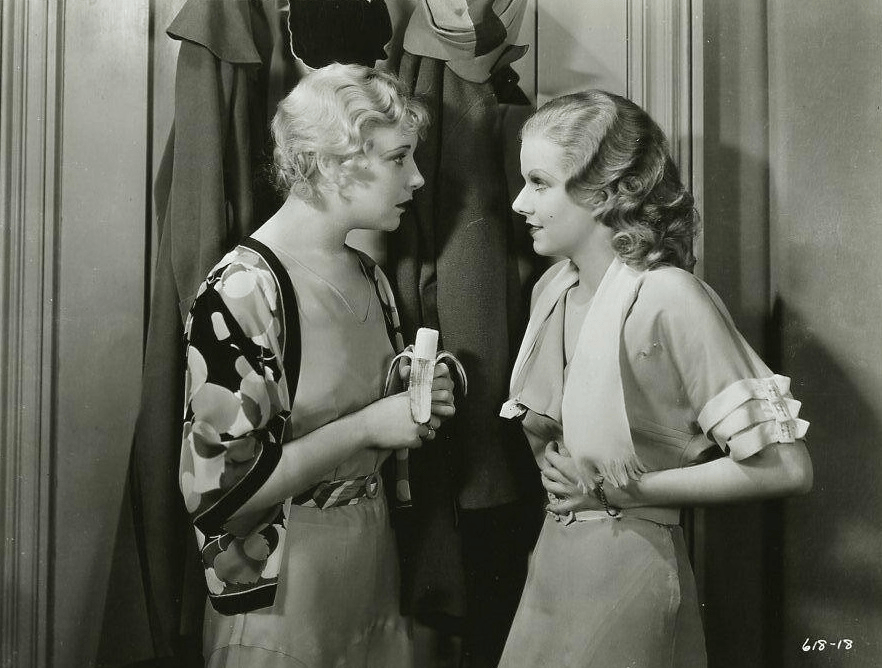
I was recently regretting the lack of Jean Harlow talk in Patsy Kelly’s later interviews (can’t blame anyone when they costarred but once), but luckily, four-time Harlow costar Merkel WAS asked, by the astonishingly prolific interviewer Richard Lamparski. Lamparski asked Merkel, who worked with everyone from Marlene Dietrich to Burl Ives, about her favorite films, and Harlow’s was the first name off her tongue, which says much about how the platinum blonde ranked with her. Below is a excerpt from a circa 1968 talk with Una (who reminds us to pronounce her name with a soft ‘U’):
Richard Lamparski: “You didn’t tell me, though, about your favorite pictures.”
Una Merkel: “Well, there’s so many! I did about six* with Jean Harlow, and I enjoyed every one because I loved Jean and the parts were good.” *It was four.
Lamparski had her elaborate later on:
RL: “What was Jean Harlow like?”
Una: “Wonderful. Generous, and kind, and rather shy, believe it or not.”
RL: “Yes, I don’t think most people think of her as being shy.”
Una: “Well, she was. We used to sit on the set, we—I remember definitely one time, where they had a set with two rocking chairs. We were waiting for a setup, you know it takes a long time to get the lights ready and everything, and she and I sat there for two hours and rocked back and forth and talked. And Debbie [Reynolds] and I have done that, too.”
Instead of six films, a number Merkel happily misremembered, their four are Red-Headed Woman (1932), Bombshell (1933), Riffraff (1936), and the unfinished Saratoga (1937). Merkel, like much of Hollywood and the Americans who imbibed it, was devastated when Harlow died at the peak of her career during the production of what was destined to be their last film together. Merkel wrote to a friend two weeks after Harlow’s death in a letter dated June 24, 1937: “I’ve worked rather hard—and long—(over 2 months)—on Saratoga, and of course I felt so terribly bad when Jean Harlow died —for she was a grand person.”
Merkel’s missive further proves that Harlow truly was one of the most performers in town; the only evil eyes cast toward her seemed to come from the skulls of Wallace Beery, briefly Joan Crawford, and occasionally Marlene Dietrich (whose capriciousness about Harlow excuses her).
This full interview (and some others) are available to listen to on Archive.org. Lamparski did them for New York’s WBAI radio station, and the rights are held by Pacific Radio Archives. These quote excerpts are used under the principle of fair use, and are being shared for educational purposes without profit.