I’m primarily on Substack nowadays, but as this site’s blog is still sporadically in use I might as well put it here too (since it is, well, about Jean Harlow).
Maisie (1939) is one of the seminal ingredients in Ann Sothern’s saucy filmography, which renders the fact it wasn’t initially planned with her in mind slightly humorous. Sothern, hitherto only a capable B-actress with a few leading roles under her belt, allegedly owed the elevated echelon she achieved with the highly successful string of ten Maisie films and its further spinoffs to the sudden death of reigning bombshell Jean Harlow. What makes this assumption even more amusing is that Maisie was not originally planned for Jean Harlow, either.
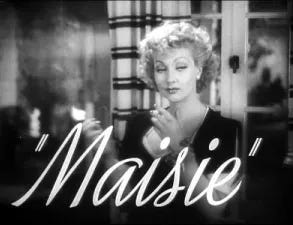
Harlow, who was buried long before Maisie was even dignified with a completed script, would have made a choice characterization of the film’s titular character in the medium’s golden year: brassy, blasé, buoyant, and best of all, played as convincingly unaware of it all. However, the fable of Sothern stepping into Harlow’s shoes—likened to dancer Mary Dees taking over her half-finished Saratoga—isn’t altogether true. Legend dictates that Metro-Goldwyn-Mayer purchased the rights to Maisie just before Harlow’s death and was forced to stall the project until Sothern proved a suitable replacement in 1939.
In reality, Maisie’s source material had been floating around the studio for nearly half the time Harlow had been there. The film was formed from a Wilson Collison novel titled Dark Dame; Collison also happened to be the author of Blonde Baby, which was turned into Three Wise Girls (1932) at Columbia starring Harlow in her first top billing. More importantly, Collison penned the original stageplay of Red Dust produced in 1928; the triumphant Harlow-Gable version on celluloid still smolders nearly a century later.
Collison went on to publish Dark Dame in February 1935, which a contemporaneous Kirkus review categorized as “readable trash—a western with more complexity and romance than usual, in the story of a New York girl who lost her heart to a cow-puncher, and won him from the sophisticated woman who interfered.”
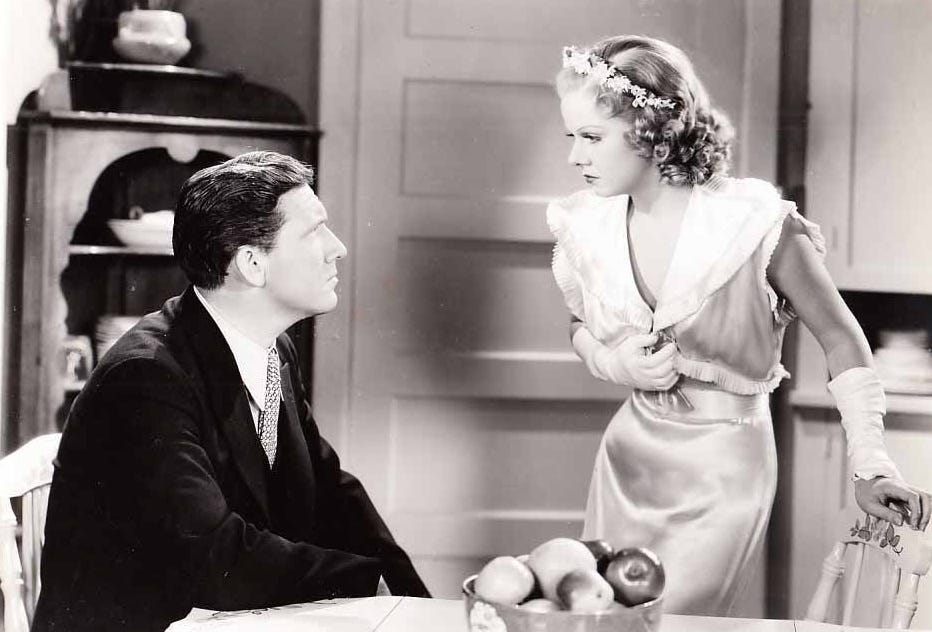
MGM circled over, then quickly swooped in on the so-called ‘trash’, the rights to which were acquired by the studio that spring. By April, the trades were noting that screenwriter Jack Kirkland (of Tobacco Road notability) and Jesse Lasky, Jr. were working on a treatment called Little Miss Nuisance which slated the newly signed Spencer Tracy, Jean Arthur, and up-and-coming Rosalind Russell as the principal love triangle.
1935, however, was a transitive year for the film industry, and neither Jean Harlow nor Little Miss Nuisance were spared. Harlow’s screen image was in the midst of turning over from hotcha-plat-blonde to chummy ‘brownette’ this same year; this transformation was partially meant to subdue her torrid style in the wake of the draconian new Production Code. She needed a new, milder way to sell herself without pulling from the same bag of tricks. Internally, there was a small crisis over Harlow’s change in star power and what roles she’d portray going forward, which coincided with a mad rush to save her then-overbleached hair.
Apex glamour photographer George Hurrell’s assessment of the situation says enough: “They tried everything. They even put her in a black wig.”
Harlow herself had already expressed a great desire to be given the chance to do dramatic stories for a long while: “I begged and begged for a part in which I wouldn’t have to speak bad English and slink up to ‘my man’.”
Meanwhile, Kirkland and Lasky, Jr. had finished their share of work on Little Miss Nuisance and stepped off the project in the summer of ‘35; it apparently wasn’t satisfactory, as Lynn Starling then attempted his own screenplay, which he did not complete (and which rests forever unfinished on ninety-five pages in the Margaret Herrick Library, next to the unused Kirkland-Lasky version).
The trades and general press had caught on to Harlow’s consideration for the film, and now reported that she, instead of Arthur, was to tackle it headlong. “Jean Harlow’s next picture has been picked out,” columnist Pettersen Marzoni whispered from behind his hand in an August item for The Birmingham News, “Little Miss Nuisance is the story and it has been hanging around the Metro office for a long time looking for someone to play it.”
But MGM needed a film for Harlow quicker than its best minds could whip Little Miss Nuisance into a shape that fit her. Screenwriter Ruth Cummings (who poured her mind into romps like Our Dancing Daughters) and venerable silent veteran Harvey Gates were given a turn into September, but to no avail; Harlow had by then started production on Riffraff with Spencer Tracy instead, and Nuisance was reported as ‘shelved’. Dorothy Parker and husband were then tasked with weaving its remaining threads together in October, without any indication of any future Harlow involvement.
There wasn’t much room for Harlow in the Nuisance equation from here; her characterization of Riffraff’s gold-hearted hoyden, Hattie Tuttle, is considerably similar to what Sothern would do later with the shelved character who would become her titular Maisie; one could venture to say Harlow’s Hattie Tuttle is her own true Maisie Ravier. Harlow then quickly segued into Wife vs. Secretary at the close of ‘35, which would give her much more to chew on—a role Harlow biographer David Stenn calls her first with ‘subtlety, dignity, depth, and class’—than Nuisance could have provided. After Harlow’s death in ‘37, Nuisance had received yet another treatment under the title of Love Is My Witness and had long been divorced from the former platinum blonde entirely.
Incessant dreams, questions, and wishes unleashed by Harlow’s demise at the pinnacle of her sensational career often overshadow the fact that at the time, she was breaking her typecast mold to move into an entirely different type of role; that of the offbeat patrician with a great sense of humor, which was actively coming to fruition in Personal Property and Saratoga (both 1937). What would Maisie have given Harlow during her metamorphosis other than reheated B-picture leftovers of the same parts she’d played to death, undeserving of an established star? It was high time to pass the baton either way. Notably, the film is absent from MGM’s 1937-8 campaign book for upcoming releases, which instead describes Harlow’s potential involvement as an impresario’s bored wife in a film titled The Best Dressed Woman in Paris (the studio would then release a version of the pressbook with Harlow’s films struck out after her death). Maisie would have been a step backwards for Harlow, whose producers—especially Hunt Stromberg—were obviously taking care to invest in nurturing a well-rounded image for her going forward.
The Jean Harlow-Maisie pipeline does not end after the first film in the series. The first sequel, Congo Maisie, was unsurprisingly taken from yet another Wilson Collison novel, which one can glean from its sheer similarity in mise-en-scène to Red Dust (1932). Congo Maisie’s source material was Collison’s Congo Landing, which itself is an expansion of an original story he’d already written and sold to MGM in 1933 called Dolly.
Dolly was originally conceived as a wholly separate production before Dark Dame was put to print, and was set to star stage newcomer Gladys George with director Gregory La Cava at its helm. This idea disappeared, though, as soon as Collison’s reworking of it was released in 1934.
The main character of the refurbished Congo Landing, the same Dolly, was what Beatrice Sherman of The New York Times called a ‘canny and discerning little blonde’ whose personality was ‘cheerfully vulgar’. She and her husband take a steamer down to the Congo, where they enter into a love quadrangle with a doctor and his lonely wife (and illustrate Collison’s emphatic fascination with love affairs reflecting the steaminess of the ‘exotic’ locales they take place in).
Before it was nailed down as Congo Maisie, the Dolly story was passed through the hands of Erich von Stroheim, who gave it a treatment called Purple Night…which was then briefly announced by Louella Parsons as Jean Harlow’s newest upcoming film in January 1935.
“The moment Jean Harlow finishes “Reckless” with Bill Powell she will get ready for “Purple Night” which Bernard Hyman will produce,” wrote Parsons, adding “Jean will sing not only one song but three or four.”
It doesn’t take much more than the knowledge that Reckless, Harlow’s singular musical, proved the first and only of her films to lose money to stop wondering why a melodious Purple Night was never realized for her. Someone at MGM, though, discovered years later that these two separate Wilson Collison novels would work well together if played as one series, and delivered both Purple Night and Little Miss Nuisance to screenwriter Mary McCall Jr.’s desk in 1939. She tweaked both, the Maisie series was born, and the studio was able to jumpstart Sothern’s career with a pair of forgotten properties.
Congo Maisie, like its predecessor, stars Ann Sothern, who this time is in competition with Rita Johnson’s Kay McWade for the affections of Gable lookalike John Carroll on an African rubber plantation (Johnson just so happened to be one of the starlets knocked from the running for Harlow’s Saratoga double). Sothern’s Maisie, unlike Harlow’s Vantine, is deflated by post-Code, pre-War optimism and self-reliancy that has her knitting and performing magic tricks instead of tending to a caged bird while slinking around in busty negligees. Where Red Dust gains dramatic speed with the continued goings-on of an illicit affair, Congo Maisie sputters and stalls as Sothern’s titular character condemns her involvement in one outright, taking the other woman’s side and saving her competition from sin.
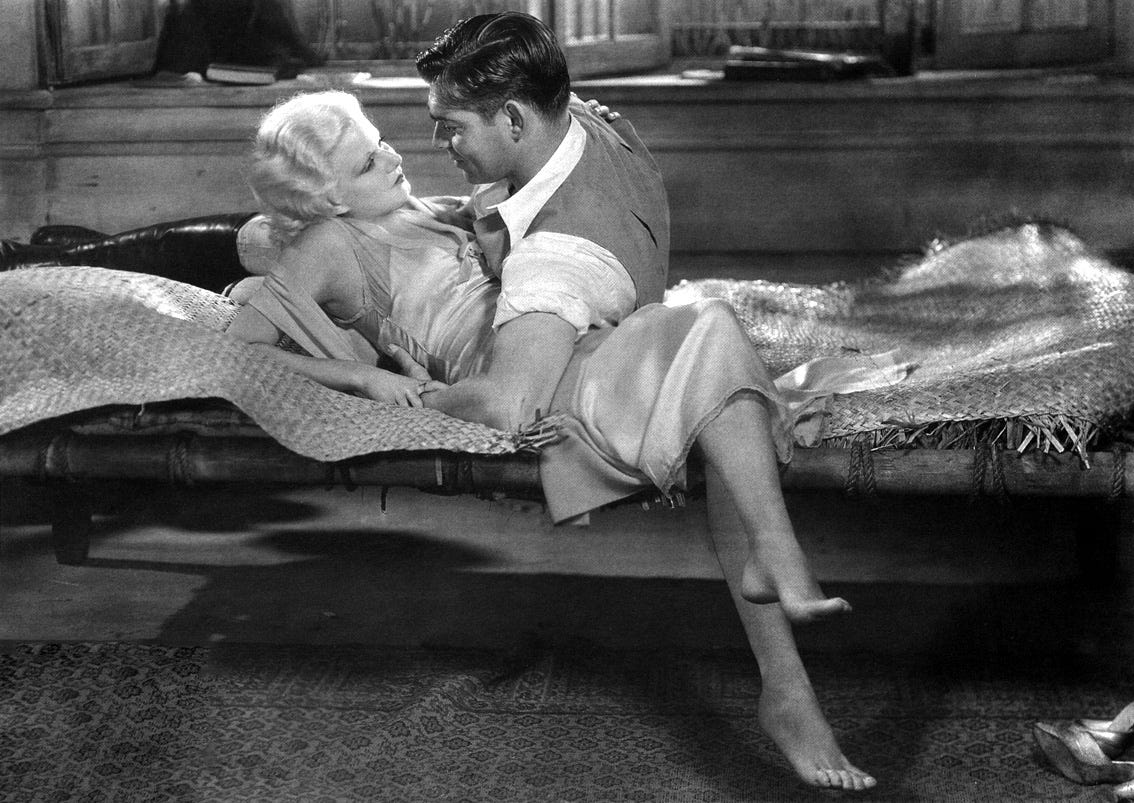
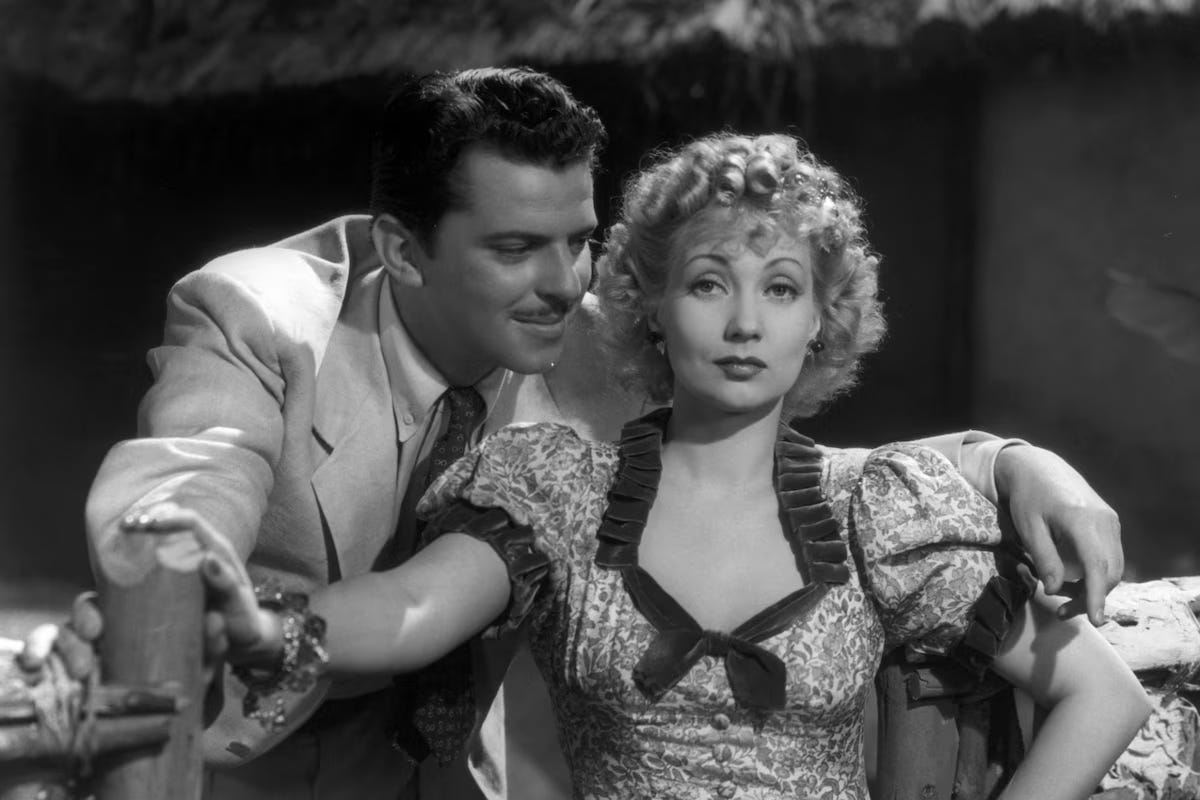
Maisie’s saving of her leading man’s marriage instead of throwing it under the bus was a prominent plot thread in the first film, and goes to show how the Harlow-homewrecker type would be dead as a doorknob until the relative, unempathetic resurrection of naughty women with film noir. Maisie’s personhood as an ‘undesirable’ woman—a roving showgirl who doesn’t shrink to the shape of a housewife—is based in acts of service for others, which balances out her hardboiled exterior and keeps her on the right side of the cinematic tracks. Whereas Harlow pined for, searched for, and begged for ‘her man’, Sothern fought him off, and made sure he stayed gone with a wary eye in order to preserve her own brand of Forties respectability.
Red Dust and Congo Maisie were so similar that the second is often mistakenly referred to as a remake of the first, and was actually billed by MGM as being ‘racier than Red Dust’. Its production well after the enforcement of the Code, however, ensured no residual heat burned through. What Congo Maisie lacks in raciness it more than makes up for in racism; it takes a certain amount of effort to outdo the Asian caricatures of Red Dust with ‘spooky’ voodoo rituals from circles of restless African natives who could only be quelled by the appearance of Maisie in her conspicuously modest feathered burlesque costume.
While Maisie would have been a decidedly effortless role for Jean Harlow to pull off, the impact of her storied death goes even further than the rise of Ann Sothern through her hand-me-downs; it cemented the place of the wisecracking blonde in film and spawned a legion of derivative personalities that, like moissanite or pyrite, radiate their own individual sparkle but lack the particular depth and charm of the Harlow diamond.
Sources:
1. Dark Dame manuscript by Wilson Collison, 1935. Maisie file, Turner/MGM scripts, Special Collections, Margaret Herrick Library (https://academycollection.org/web/arena/search#/entity/academy/71390519/maisie). Accessed Feb. 2026.
2. “Dark Dame.” Kirkus Reviews, 15 Feb. 1935, http://www.kirkusreviews.com/book-reviews/a/wilson-collison-2/dark-dame/. Accessed 15 Feb. 2026.
3. “Screen Writers’ Assignments.” The Screen Guilds’ Magazine, Apr 1935, p. 12.
4. “Nuisance” for Tracy.” Motion Picture Daily, 7 May 1935, p. 15.
5. Stenn, David. Bombshell: The Life and Death of Jean Harlow. Doubleday Books, p. 191.
6. Hartley, Katharine. “Jean Harlow’s Dangerous Gamble.” Hollywood, Mar 1936, pp. 26-27, 70.
7. “Screen Writers’ Assignments.” The Screen Guilds’ Magazine, Jun 1935, p. 14.
8. Temporary incomplete Little Miss Nuisance screenplay by Lynn Starling, July 1935. Maisie file, Turner/MGM scripts, Special Collections, Margaret Herrick Library (https://academycollection.org/web/arena/search#/entity/academy/71390529/maisie). Accessed Feb. 2026.
9. Marzoni, Pettersen. “Current Highlights.” The Birmingham News, 28 Aug 1935, p. 15.
10. Temporary incomplete Little Miss Nuisance screenplay by Ruth Cummings and Harvey Gates, August-September 1935. Maisie file, Turner/MGM scripts, Special Collections, Margaret Herrick Library (https://academycollection.org/web/arena/search#/entity/academy/71390531/maisie). Accessed Feb. 2026.
11. Niemeyer, H.H. “Hollywood.” St. Louis Post-Dispatch, 8 Aug 1935, p. 2D.
12.”Out Hollywood Way–Writers.” Motion Picture Daily, 4 Oct 1935, p. 13.
13. Temporary incomplete screenplay of Love Is My Witness by Howard Wilson and Hannibal Towle, November 1937. Maisie file, Turner/MGM scripts, Special Collections, Margaret Herrick Library (https://academycollection.org/web/arena/search#/entity/academy/71390539/maisie). Accessed Feb. 2026.
14. Dolly story by Wilson Collison, c. 1933. Congo Maisie file, Turner/MGM scripts, Special Collections, Margaret Herrick Library (https://academycollection.org/web/arena/search#/entity/academy/71380665/congo-maisie). Accessed Feb. 2026.
15. “Metro Buys Collison Story.” The Film Daily, 13 Nov 1933, p. 12.
16. Sherman, Beatrice. “Congo Landing.” The New York Times, 15 Apr 1934, Section BR, p. 19.
17. “Rivkin and Wilson on ‘Dolly’ Screen Play.” The Hollywood Reporter, 1 Jun 1934, p. 5.
18. “We Cover the Movie Front–Inside Flash From Hollywood.” Broadway and Hollywood Movies, August 1934, p. 6.
19. Purple Night treatments by Erich von Stroheim, August-September 1935. Congo Maisie file, Turner/MGM scripts, Special Collections, Margaret Herrick Library (https://academycollection.org/web/arena/search#/entity/academy/71380678/congo-maisie). Accessed Feb. 2026.
20. Parsons, Louella O. “Jean Harlow Will Play In Purple Night.” Capitol Hill Beacon [Oklahoma City], 14 Jan 1935, p. 3.
 Harlow Heaven