(This is a crosspost from my Substack, where most of my new writing lands nowadays. Please consider a subscription (free or paid) if you enjoy my writing, which has never been AI-assisted or arranged). The title is in reference to Paramount’s inability to cash in on this woman.
Minnette Shermak was the first recognized Jean Harlow superfan in the early 1930s. With clubs and cults of personality cropping up with increasing frequency as far back as the silent era, Shermak found herself in the vanguard of the talkie’s defenders, coming into prominence as the first President of the Official Jean Harlow Club when she was just a teenager. The name of her mimeographed Harlow fan publication, The Platinum Page, lived well after Harlow’s 1937 death; it was knowingly borrowed as the title for the first Jean Harlow internet fan website in the 1990s (now only viewable on the Internet Archive). Shermak’s influence is palpable: while fan magazines published lists of hundreds of fan clubs and their leaders, her sheer youth, gender, and tenacity set her apart from the scores of matrons and hobbyists who occupied her same position.
At risk of tooting my own horn, I’d venture to call Shermak’s work with The Platinum Page a parallel to and a forerunner of Harlow Heaven. Like Shermak, I too became entrenched in fan spaces at that whirlwind age when the insatiable appetite for discovery bites one on the neck and converts the dilettante into the fanatic. Both of us dedicated our ensuing early twenties producing reams on the same person: though mine came from a neutral, historical standpoint, while hers was up-to-the-minute, intersecting directly with the Platinum Head herself, then vibrantly alive and not yet totally reduced to tragedy.
Minnette Shermak entered the world on August 1, 1915, in Chicago, Illinois, as Hermine Josefine Shermak.1 Her Hungarian-born Jewish parents were John Shermak, a tailor, and homemaker Irma Jasper (or Gaspar). She had no known living siblings. By the age of four, after the small family had relocated to the bustling melting pot of New York’s Upper East Side, the only child was simply called “Minnie.”2
Shermak was immersed in films from a tender age; as she was already a card-carrying member of the Lew Ayres Fan Club by the age of fifteen, we can safely assume she spent her childhood enthralled by the magic of a dark theater like the many children of her generation around to see the transition from silent to sound were.3 It would be the new crop of sound stars who captured Shermak’s teenage fascination, and it seems the affair with Ayres was fairly short-lived. By early 1932, she was firmly entrenched with the rising star of the year, perhaps the actress most emblematic of the evolving, fast-paced talkie: Jean Harlow.
“I have had the extreme pleasure of meeting Jean Harlow and knowing her personally,” the sixteen-year-old boasted from her 83rd Street address to Picture Play magazine that year, “To the many fans who believe Jean to be ever so daring and wicked, I only want to say this—please don’t imagine this to be publicity, but the honest truth—Jean Harlow is the simplest, sweetest, and most natural girl in the movies today.”
Shermak didn’t stop here. “If you were to know her, I am sure you would all hold her as your favorite star,” she argued, “She is a direct opposite of the type she portrays on the screen. Now doesn’t that prove her to be a grand actress?”
“Here is a girl who wants to be known for her acting, not the shape of her body,” ended the precocious missive.4 It was actually a brave and unique stance at the time it was written in the spring of 1932: Harlow only came to Metro-Goldywn-Mayer on April 20, and before that date (as well as some time after it), she was still a household name for all the wrong reasons. Having made a splash in the world of sex as the blonde topping on Howard Hughes’ Hell’s Angels (1930), the inexperienced Harlow was used by Hughes as a cash cow to recoup his bottomless investment. The films he loaned her out for exploited only her eye-popping image and not her eerily natural sense of comedic timing. Harlow spent the year 1931 essentially being a glorified laughing stock, a status she was well aware of, and she wasn’t even laughing all the way to the bank for her trouble: Hughes only tossed her a small portion of her own earnings.5
Shermak’s reverence was earned early. Harlow’s momager—the indomitable “Mother Jean” Bello—would have been responsible for forging the friendship by typing correspondence and making dates. A whip-smart businesswoman, Mother Jean was well aware of the benefits of a sex symbol being open and courteous with her public: especially the young women she could not afford to alienate. “I get about fifty letters from women to every one from a man, and they all seem for me,” said Harlow, who spent the winter of 1931-2 making personal appearances on the East Coast: she would have undoubtedly linked up with Shermak in New York at this time.5 Soon after, Shermak and her parents relocated to East 90th Street, where the rest of her fan activities would originate.6
The teenager kept sounding off throughout 1933, dropping letters full of her platinum positivity to Picture Play in particular (while decrying Harlow’s ongoing persecution): “I am indeed very proud to boast of my two-and-a-half-year friendship with her,” wrote Shermak, “I became acquainted with Jean at the time when she was just another film beauty. She was perfectly charming to me—sent me gorgeous photos and letters and offered to meet me twice. As time went on, however, and Jean became one of filmdom’s greatest stars, I became a bit frightened, frightened for fear that she would “go Hollywood” and I would lose my treasured friendship with her. But when I tell you that success made Jean Harlow an even sweeter, more charming, and thoroughly unaffected person, I am sure that you all will believe me. Jean writes to me regularly, and these letters are indeed a supreme joy. I receive beautiful photos from her, and now I am eagerly awaiting my promised date with her when she comes to New York again.”6
By 1934, Shermak’s eloquent passion had elevated her to the post of President of the Official Jean Harlow Club, a position formerly occupied by Miss Ynona Hall.7 She turned nineteen the same year, and soon began work on The Platinum Page, which talked of Harlow’s films and other goings-on.
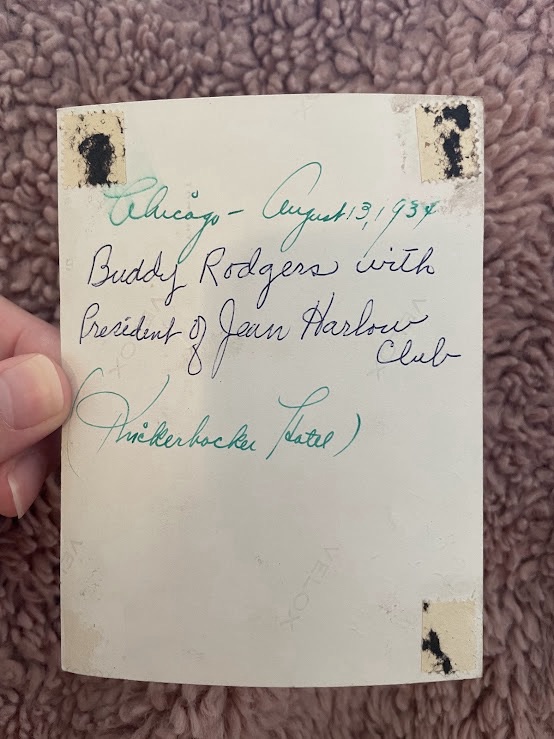
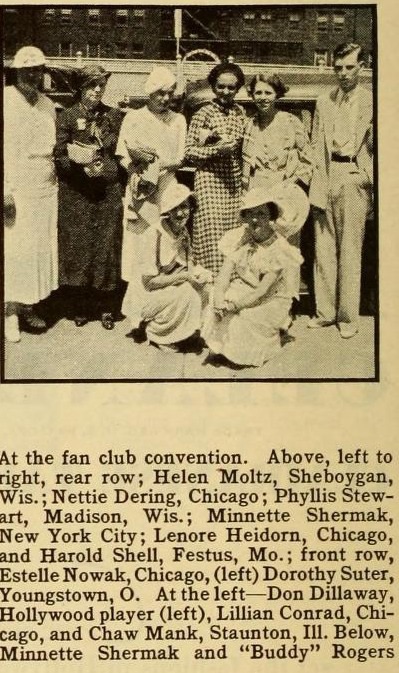
In mid-August, she traveled to her hometown of Chicago to represent the Jean Harlow Club at the Second Annual Movie Fan Club Convention. Secretary Dorothy Suter, of the Club’s Ohio outpost, accompanied her. On August 13 (a date confirmed by Shermak’s own handwriting), an official club luncheon was held in the Silver Room of the Hotel Knickerbocker, with Charles “Buddy” Rogers as the guest of honor: as it was his thirtieth birthday, a dinner party was given for him at the Hotel Sherman.8
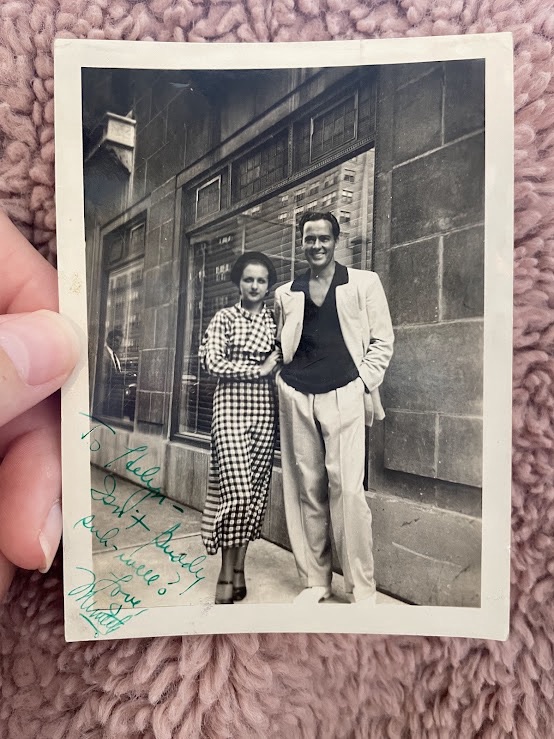
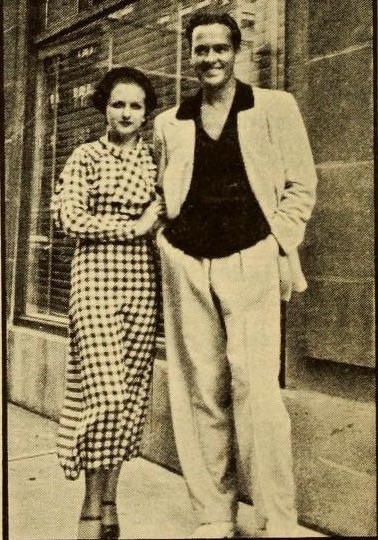
“Isn’t Buddy suh-well?” wrote Shermak to a friend, in green pen, on a snapshot of her and a beaming Buddy taken outside the Knickerbocker. The same photo was published in Photoplay alongside a laundry list of various club leaders and the activities they shared at the Con. Ninety years later, it became a part of my collection.
That November, Harlow and her mother took a rare break from each other when the latter was compelled to go “East” for what was called doctor-ordered rest.9 Shermak filled the void that was surely in Jean Bello’s heart: the two of them dined together. “President Minnette Shermak writes that she and her mother enjoyed a lovely luncheon with Miss Harlow’s mother, on her recent visit to New York,” was Photoplay’s terse report.10
The same month, the teenager—standing united with some 1,999 others—spearheaded a Fan Club Federation effort to curb “false stories” on screen stars filling the gossip columns. While this probably had roots in the recent Production Code changes (and film exhibitors were more than happy to oblige the good publicity), there were less frivolous efforts, too. Restructuring happened within the Clubs, which were now forbidden from asking their namesake stars to help fund their efforts. Members themselves were made to pay yearly dues to offset this—fifty cents’ worth—which caused some eye-rolling from the depths of the Depression, when the average movie ticket was a quarter. Shermak, still President of the Harlow Club, was now an Officer of the Fan Club Federation as a whole.11
The Fan Club Federation published its own quarterly magazine, Fan Club Fare, which Shermak also wrote for. In 1935, she contributed a piece called Fashion Designing with Charles LeMaire. Photoplay shared in its fan club-exclusive column that it was “going to interest all members.”12
A further clue on this can be found just the next year despite the non-survival of the article itself: Shermak was twenty-one in 1936, when she registered to vote as a Democrat in New York. She named Charles LeMaire, the same noted fashion designer, as her employer.13
Meanwhile, Jean Harlow herself, also a bona fide writer, was crowned with the opportunity of becoming a contributor for The Platinum Page. Photoplay published an excerpt of Harlow’s article about her dressing room:
“The drapes are of a crepe in what is called ‘Ice White’—the exact shade of the walls. The furniture is antique white tipped in antique gold. The little French chairs are upholstered in different shades of white, some being quilted satin and others in fine brocade satin. In the dressing room proper the chairs and dressing table stool are done in oyster white velvet. The apartment also has an enclosed refrigerator that has the same mirrored panels as the wardrobes, and above that has shelves of white wrought iron. Mother gave me a delightful surprise by sending me a complete luncheon set of white Wedgwood, plain crystal glass with my monogram. Well, in all, it is indeed a lovely and cozy studio home, with radio and phonograph combination.”12
Shermak’s affections branched further out as she matured (they were not exclusive to Jean Harlow): by 1935, she was also in a fan club for charming blonde actress-singer Vera Van.14
She’d probably need to lean on the distraction in the coming years, as Shermak, like the rest of Harlow’s public, was blissfully unaware of how little time they had left with her.
It’s not known what Shermak’s thoughts were or how she reacted after Jean Harlow’s sudden and headline-snaring death on June 7, 1937. She gave no big heartrending statements on her favorite actress to any enterprising sob sister that may have wanted them, despite her flair for Harlow-themed write-ins. There were no known romantic memoirs sold to Photoplay titled “My Friendship with Jean Harlow” or “In Memory of My Great Friend, Jean.” Instead, she kept on quietly working in fan spaces, working her way up to be one the seven female directors of the Fan Club Federation.15
In 1939, Shermak appeared on her mother’s American naturalization petition as one of her key witnesses; the family had since moved to an apartment on Nelson Avenue in the Bronx, and the young woman, now twenty-four, supported her family as a sales accountant.16
Though Shermak’s activities in fan circles did dwindle to a full stop not long after Harlow’s death, the cessation seems to have corresponded with her own life coming into bloom. In November 1940, she married her “longtime” boyfriend, Harry Levine, in the Bronx.17,18
“Theirs was a love affair for the ages,” Levine’s nephew wrote of the couple in a public Facebook post, “Harry couldn’t marry because he was breadwinner for his family as well as caretaker for his father who had Parkinson’s for many years.” Levine finally married Shermak after his father’s death; perhaps The Platinum Page kept marriage on the back burner, too.
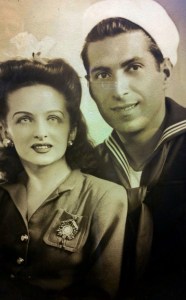
But the happiness and satisfaction was fleeting. Soon after the rice was thrown, big-hearted Levine enlisted in the Navy as a medic as the country entered World War II, leaving his wife at home while he braved the European theater. In April 1944, he was stationed on the USS LST-531 just off Slapton Sands in the English Channel, during “Operation Tiger”, an obscure and morbid rehearsal for D-Day. On the 28th, a fleet of German E-Boats torpedoed and sunk Levine’s ship, killing him and over 700 other American servicemen in the process. He was only thirty-five; his young wife back in New York was twenty-eight. His body was never recovered.
As the failure was an embarrassment for the American government, which was counting on the success of D-Day, Shermak and other new Navy widows were given minimal information on what happened to their husbands that fateful day, offered that they had simply been “killed in combat.” Levine’s nephew recalled Shermak learning the visceral details of the real truth from one of his friends who survived. Levine’s boat suffered the heaviest losses of its fleet, sinking within six minutes; a 2014 article commemorating the seventieth anniversary of Operation Tiger claimed he likely died of hypothermia while clinging to wreckage out in the open water, waiting for a rescue that would never come.18
Levine’s nephew noted that his uncle’s love story with Shermak went on for twelve years; if the math is correct, then he’d been with her since 1932, during the breadth of her Harlow happenings. Like any lover, he had to have been a confidante, and the loss for Shermak between her husband and the star who was the impetus of her career must have loomed like a dark cloud. Her father died in 1941, surely compounding the feeling.19 Life, however, went on.
In June 1948, Shermak remarried to one Louis Becker: the ceremony was performed at her parents’ apartment on Ocean Parkway in Brooklyn. 20,21 The bride wore an “afternoon dress of mauve-pink silk shantung with a matching hat.” The maid of honor, Jerrie Matatia, was an old friend from the Fan Club Federation days: this researcher had already spotted her name in fan magazines being touted as the President of Bette Davis’ Official Fan Club, headquartered in the Bronx.22
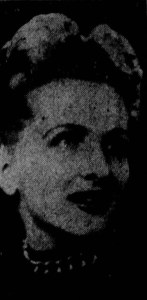
The ensuing decades were quietly family-oriented. In the 1950 census, Shermak and her second husband are shown living with her widowed mother in the same apartment on Ocean Parkway; she was working as a bookkeeper for an advertising agency. Becker was a salesman for a millinery manufacturer. Shermak’s aged eighty-five year old immigrant grandfather stayed with them.23 No other information on the former superfan’s day-to-day activities or personal circumstances can be located; the former charge of Charles LeMaire now remained perfectly happily under the Hollywood radar.
An attempt at intrusion into her private bubble was very publicly attempted in the early 1960s: of course, during the fabled production of Joseph Levine’s Harlow (1965). “Minette [sic] Shermak, where are you?” cried frantic headlines across the nation, having organized a search at Levine’s behest. The producer pleaded for anyone “with any information regarding Miss Shermak” to forward their thoughts to Paramount’s Broadway offices, as the studio intended to pick the woman’s brain for filmic research.24,25 Shermak never materialized.
In true Hollywood fashion, the coveted “first Harlow fan” was not irreplaceable in the moneyed production. When Shermak failed to respond to Levine’s beckoning after six months, she was swapped out for forty-four-year-old waiter Douglas Vranas*, whose equally shrewd fandom amounted to comparatively underwhelming public-facing accolades, such as private tour guide for the Harlow footprints at Grauman’s, the guest of honor at the unveiling of her wax reproduction, and now, publicity campaigner for her biopic. Vranas, unlike Shermak, never personally knew Harlow, though he was in his teens when she died.
“The world’s number one Harlow fan,” Levine proudly proclaimed of his find, poking again at Shermak’s reticence by claiming she’d missed out on appearing in the film and its advance publicity, “Prospects are bright now that waiter Varnas […] will fall heir to the job slated for the missing club prexy.”26
While the film bagged millions of dollars, it was still a critical bomb, and, like Harlow’s own pre-MGM loanouts, it became a laughing stock instead of a cult classic in later years. Shermak probably recognized she was only wanted for ballyhoo, a concept she’d surely have become familiar with from chatting with Harlow herself. Perhaps she even knew how rotten the source material (Irving Shulman’s Intimate Biography) was, unlike Vranas, who swore up and down that he hadn’t read the book and never intended to, preferring not to “shatter his ideals”. One wonders if the finished film was a wake-up call.
The middle-aged Shermak pushed on quietly without caring to exploit her memories, eventually retiring north to Great Neck with her husband and now-elderly mother.27 Mrs. Shermak predeceased her daughter late in 1985, and Becker followed in 1987, leaving Shermak mostly alone; she had no children, siblings, or known extended family in the area, likely leaning heavily on friends, if they were around.28,29
In 1989, Shermak was living on a “sprawling ranch” at 23 Martin Ct. in coastal Kings Point, New York—though the concurrent presence of another family at the same address suggests she was renting space from them—when things took a turn for the worse. On the night of Friday the 13th that October, Shermak got into her Lincoln sedan and set out for a drive. On the way, likely due to low visibility, she collided with the rear of a 1984 Ford and lost control of her vehicle, careening chaotically for over four hundred feet before her Lincoln left the road and smashed head-first into a tree. Shermak was pronounced dead at the scene; she was seventy-four years old.30, 31, 32, 33
The only obituary carried for Shermak in the press was the play-by-play of her fatal accident, tying her into an especially deadly week for county car accidents. She simply passed as quietly as she lived, without fanfare, pity, publicity, or promotion. She was promptly buried next to Louis Becker at Beth Moses Cemetery in West Babylon, where she rests today, her memories of Jean Harlow, film fan clubs, mimeographs, and true love unfairly ended lying with her.34
Over the years, some of Shermak’s Platinum Page ephemera has found its way out into the world and other Harlow collections via auctions, though there is no dedicated Minnette Shermak Collection at any major university.
While Shermak’s personal life was indeed brimming with strife, as another Jean Harlow devotee, I don’t believe in assigning victimhood to those unable to speak for themselves. The first Jean Harlow superfan could certainly be written off as having a life as sorrowful and penitent as her favorite, in perfect rhythm with the money-hungry tactics producer Joseph Levine used to promote his Harlow parable. But to me, the life (and accomplishments of) Minnette Shermak are a testament to eschewing loudness and bravado, choosing to protect one’s peace and precious memories from Hollywood marketing hounds, valuing self-assured truth over trying to probe a glittering mist of skulduggery for three seconds of fame and a few hundred dollars. That, in itself, is honorable.
Sources and Notes
- Birth certificate for Hermine Josefine Schermak, 1 Aug 1915. “Illinois, Cook County Birth Certificates, 1878–1922.” Index. FamilySearch, Salt Lake City, Utah, 2009. Illinois. Cook County Birth Certificates, 1878–1922. Illinois Department of Public Health. Division of Vital Records, Springfield.
- “United States, Census, 1920”, FamilySearch (https://www.familysearch.org/ark:/61903/1:1:MJBT-S2Q : Wed Oct 14 05:50:06 UTC 2026), Minnie Shermek in entry for John Shermek, 1920.
- “The Answer Man.” Motion Picture, June 1931, p. 86.
- “What the Fans Think—Sweet Platinum Blonde.” Picture Play, July 1932, p. 10.
- Stenn, David. Bombshell: The Life and Death of Jean Harlow. Doubleday Books, pp. 50-51, 55-56.
- “Information, Please—Mighty Lak a Rose.” Picture Play, Feb. 1934, p. 9.
- “Cottage Hill Revival Closes.” Pensacola Journal, 18 June 1933, p. 12.
- “The Fan Club Corner.” Photoplay, Nov. 1934, pp. 92, 93.
- Dictated letter from Jean Harlow to pen-pal “Nellie”, postmarked November 16, 1934. “Mother is in the East, where she went to recuperate from her recent illness. The Doctor thought that a trip would do Mother more good than most anything else at this time.”
- “The Fan Club Corner.” Photoplay, Feb. 1935, p. 121.
- “2,000 in 20 Fan Clubs Join Forces to Stop False Stories On Stars.” Motion Picture Herald, 10 Nov. 1934, p. 15.
- “The Fan Club Corner.” Photoplay, June 1935, p. 125.
- Voter registration for Minnette Shermak, 7 Oct. 1936. Ancestry.com, Manhattan, New York, New York, U.S., Voter Registers, 1915-1956 [database on-line]. Lehi, UT, USA: Ancestry.com Operations, Inc., 2023.
- “The Listeners’ League Gazette.” Radio Stars, Nov. 1935, pp. 91-92.
- “Organizations of the Screen.” 1937-38 International Motion Picture Almanac, 1937, pp. 3, 1319.
- Naturalization petition for Irma Marie Shermak, 1939 (Roll 1195, Petition No. 328765-Petition No. 329103).Ancestry.com, New York, U.S., Naturalization Records, 1882-1944 [database on-line]. Lehi, UT, USA: Ancestry.com Operations, Inc., 2012.
- Marriage license for Minnette Shermak and Harry Levine, 8 Nov. 1940. Ancestry.com, New York, New York, U.S., Marriage License Indexes, 1907-2018 [database on-line]. Lehi, UT, USA: Ancestry.com Operations, Inc., 2017.
- Shammas, Britney. “A Deadly Rehearsal for D-Day.” South Florida Sun Sentinel, 28 Apr. 2014, pp. 1A, 9A.
- “New York, New York City Municipal Deaths, 1795-1949”, FamilySearch(https://www.familysearch.org/ark:/61903/1:1:2WP2-BLN : Thu Mar 27 02:54:28 UTC 2025), Entry for John Shermak, 19 May 1941.
- Marriage license for Minnette S Levine and Louis Becker, 10 June 1948. Ancestry.com, New York, New York, U.S., Marriage License Indexes, 1907-2018 [database on-line]. Lehi, UT, USA: Ancestry.com Operations, Inc., 2017.
- “Mrs. Minnette Le Vine, Louis R. Becker Wed.” Brooklyn Eagle, 27 June 1948, p. 16.
- Haynes, Harmony. “Fan Mail.” Hollywood, Feb. 1936, p. 14.
- “United States, Census, 1950”, FamilySearch (https://www.familysearch.org/ark:/61903/1:1:6X5M-YPC8 : Tue Oct 03 01:45:53 UTC 2023), Minnette Becker in entry for Irma Shermak, 10 April 1950.
- “‘Harlow’ Producers Hunt Fan Leader.” The Morning Call [Paterson], 6 Oct. 1964, p. 26.
- “Box Office.” Rockford Morning Star, 11 Oct. 1964, p. 21.
- “Harlow Forever—Platinum Star’s Most Rabid Fan May Cash in On Levine’s Latest Shocker.” The Birmingham News, p. 11. *: Vranas’ age and surname are incorrect in these publicity releases; misspelled as “Varnas”.
- “Grand Prize $100,000 Zingo Mystery Winners.” Daily News [New York], 13 Nov. 1983, p. 274.
- Death index record for Irma Shermak, Nov. 1985. Ancestry.com, U.S., Social Security Death Index, 1935-2014 [database on-line]. Provo, UT, USA: Ancestry.com Operations Inc, 2014.
- Death index record for Louis Becker, June 1987. Ancestry.com, U.S., Social Security Death Index, 1935-2014 [database on-line]. Provo, UT, USA: Ancestry.com Operations Inc, 2014.
- Listing for Minnette Becker at 23 Martin Ct., 1989. Ancestry.com, U.S., Public Records Index, 1950-1993, Volume 1 [database on-line]. Lehi, UT, USA: Ancestry.com Operations, Inc., 2010.
- “Buffalo News—Super Jingo.” The Buffalo News, 5 Mar. 1989, p. 35. There are many other listings for the same family at this address throughout the 1980s and 90s.
- “Miscellaneous—Estate Sale, 23 Martin Court.” Newsday [New York], 28 Jan. 2001, p. 342.
- Spindle, William. “3 Killed in Separate Accidents.” Newsday [Suffolk], 15 Oct. 1989, p. 38.
- “Minnette Becker (unknown-1989).” Find a Grave, 6 May 2023, www.findagrave.com/memorial/253406897/minnette-becker. Accessed 10 Oct. 2026.

