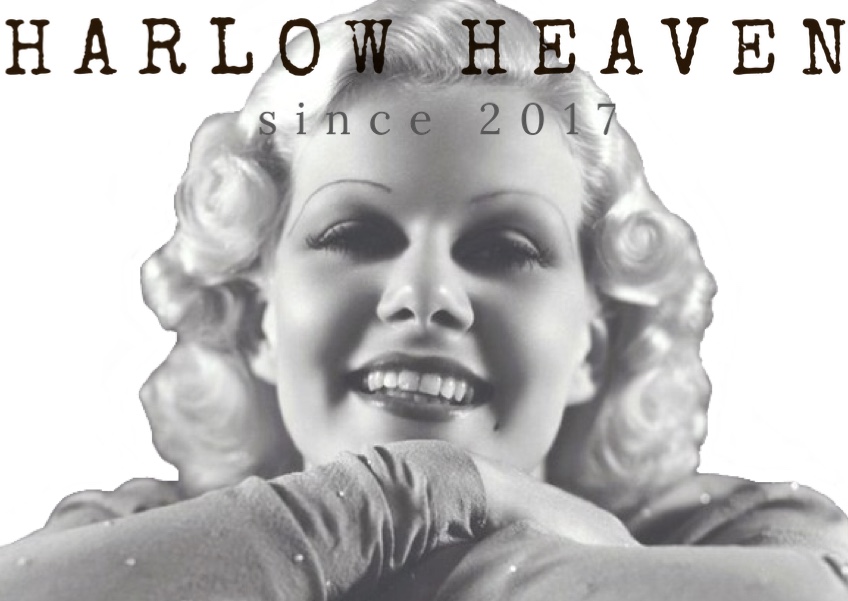
The year 1931 was a mixed bag for Jean Harlow.
She had achieved stardom practically overnight and without much thought. On the other hand, this fame didn’t necessarily result from hard work or good performances.
It was brought on by Howard Hughes’ relentless exploitation. After completing Hell’s Angels, Hughes found himself without a project for his only contracted female star. On top of that, the public hadn’t forgotten the film’s blonde seductress and wanted more of her. A businessman, it wasn’t hard for Hughes to find a solution: letting other studios borrow Jean for sleazy pictures.
A downward spiral of bad roles began, all seeming to be the same rehash of a gangster’s moll or sharp-tongued gold digger.
By November 1930, Harlow hadn’t been before rolling cameras in a year. Hell’s Angels had wrapped in late 1929 and Hughes hadn’t given Harlow anything to do except premieres and personal appearance tours in the midwest.
That changed with The Secret Six, a crime film being produced at MGM. A friend of Jean’s by the name of Paul Bern, an MGM producer, had helped convince a reluctant Hughes to loan Jean out for the production.
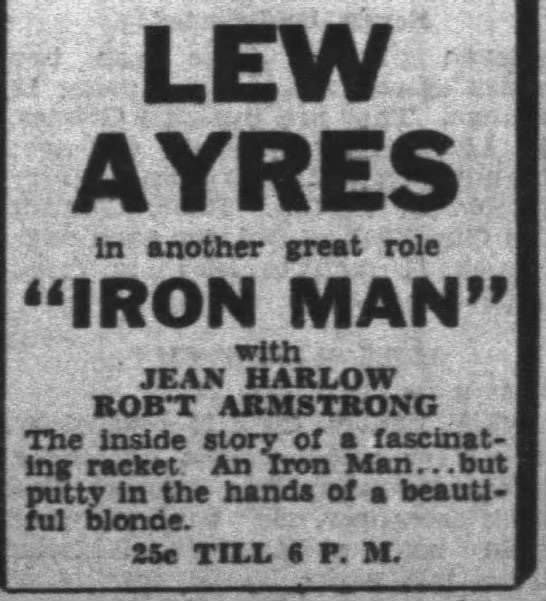
Hughes needed no convincing on whether he should loan Harlow out further; by February 1931, she was making three pictures at once. Making four pictures a year or more was common practice for established studio actors, but an amateur Jean barely had time between scenes to work on her craft. Simultaneously, she was playing in The Iron Man at Universal and The Public Enemy at Warner Brothers. Adding to the burden, Harlow was called back to MGM for retakes on The Secret Six.
All three of these films were released within a ten day span; Harlow’s image was cemented. Her sexpot characterizations were appearing across the nation in wide release. She was revered and ridiculed in publications. She was dug into on every level, her acting scrutinized and her body praised. Jean was appalled.
“She was disgusted with the sort of success she was having,” an interviewer was quoted in Bombshell by David Stenn, “She wanted to be famous, but not that way.”
After this trifecta came Goldie at Fox, which is arguably the worst role of the lot. A review from Educational Screen tersely dismissed it:
“This picture defies constructive criticism. From the point of view of taste or morals it is inexcusable. It is in no way amusing, and is so grossly offensive that one feels grubby after watching it.”
Her film appearances maximized, Hughes gave Jean a break from filming and sent her on a personal appearance tour (something she dreaded) at the Oriental Theater in Chicago that May. She also appeared at the Fisher Theater in Detroit. She stayed on the east coast until June, when she appeared in New York.
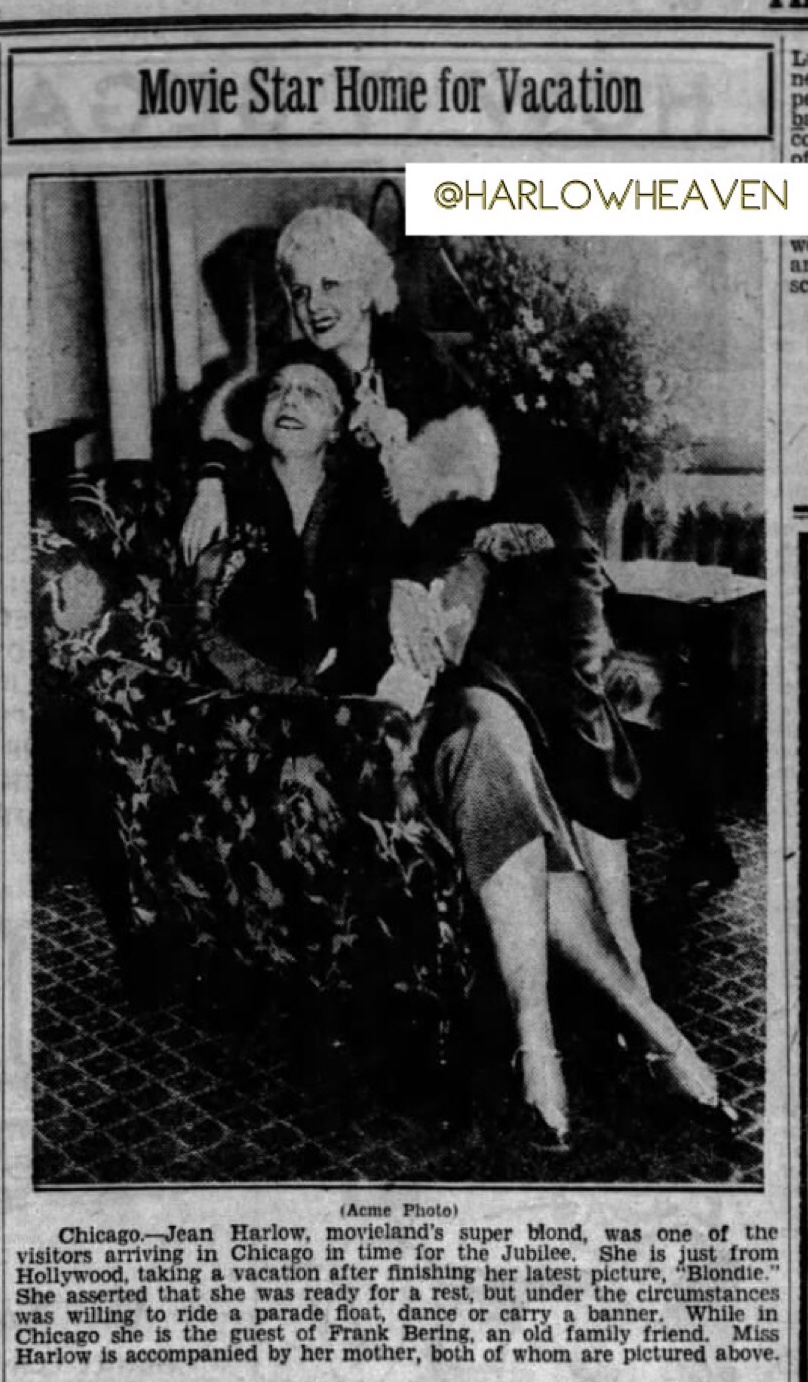
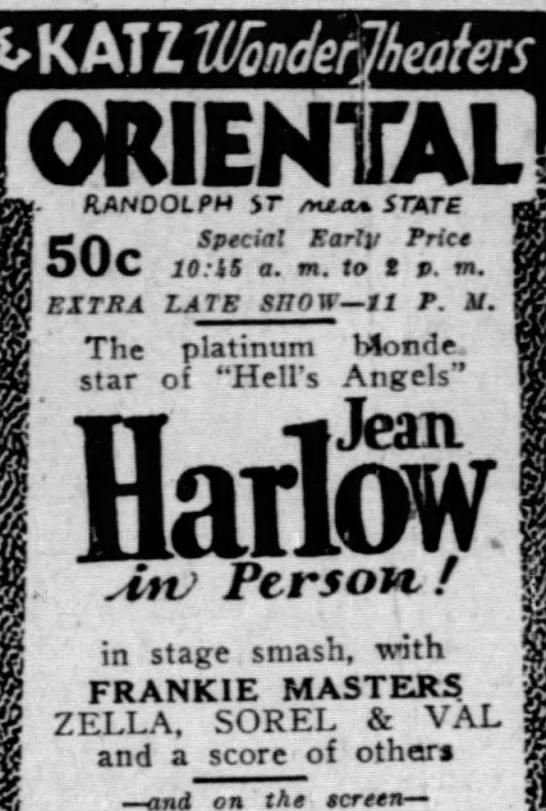
It was at one of these nights at the Oriental Theater that Jean met a pivotal figure; Abner “Longie” Zwillman. A Jewish mobster and bootlegger with a lucrative history, Zwillman was one of the biggest names in liquor smuggling. He was imprisoned in 1929 for “severely blackjacking a numbers runner who crossed him up“, news speak for nearly beating a black pimp to death. Despite his violent and homicidal tendencies, women seemed to love him. By all accounts, he was a gentleman on the surface.
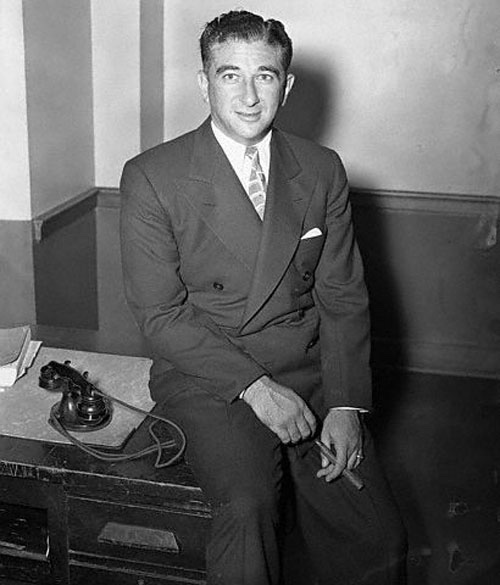
Marino Bello, Jean’s stepfather, used his stepdaughter’s allure to get on speaking terms with gangsters and the like. This had the unforeseen consequence of Zwillman taking a liking to Harlow. Though more fascinated by him than infatuated, Jean turned to him when she expressed discontentment in her roles.
Zwillman decided to get in contact with Harry Cohn from Columbia. He advanced Cohn $500,000 in cash, got Jean a two-picture deal, raised her salary, and covered the difference with Hughes. Not bad!
A contract between Hughes’ Caddo Company and Columbia Pictures was signed May 23, 1931. The two films arising from this would be Platinum Blonde and Three Wise Girls.
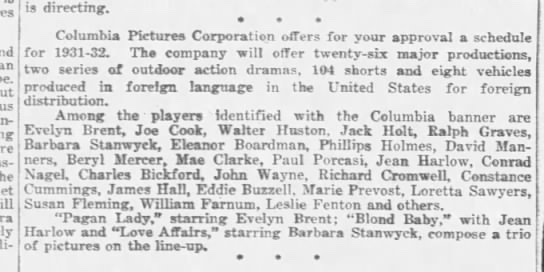
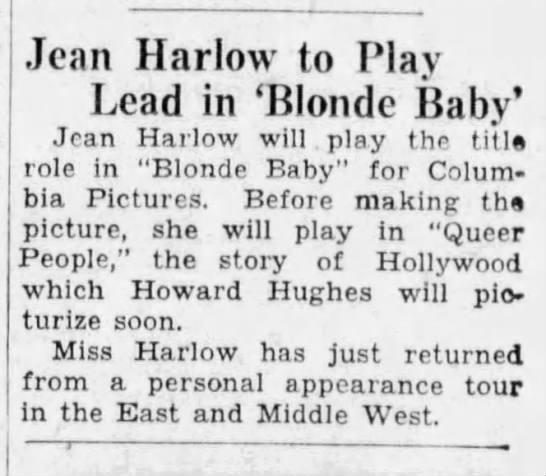
After returning to Hollywood, Jean spent August and September filming Platinum Blonde, and desperately trying to convince reporters she had talent and had been mishandled.
Instead of being taken seriously, Jean’s yearning for better roles was presented as satire in fan magazines and headlines.
“I will never play any more parts like those I have done,” she told columnist Dan Thomas in a midsummer interview, “[…] Because I am sick as being known as just a blond huzzy. I want to be known for my acting, not my body.”
Her words appeared beneath the blaring headline QUEEN OF FLICKER BLONDES DONE WITH “BAD GIRL” ROLES.
She also expressed her thoughts to Ruth Leiber of Photoplay magazine. This quote appeared in the November 1931 issue: “In Platinum Blonde, I don’t wear a dress cut beneath the throat line. I had a terrible fight with Warner Bros. over The Public Enemy, and they’ll probably never let me make another picture for them. I won’t be a vamp on the screen again. You can’t guess the pictures I’ve turned down because the moment I’m signed they change the script to undress me. I’ve decided I’m going to be an actress, not a professional sex-vulture. If I don’t, I’ll get a job as a clothes model.”
Platinum Blonde, which had originally been called Gallagher, was retitled at the insistence of Howard Hughes. The plot had nothing to do with Jean’s hair.
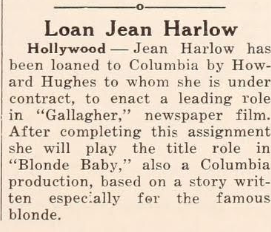
With Platinum Blonde wrapped, Jean moved on to film Three Wise Girls, directed by William Beaudine. Based off the novel Blonde Baby by Wilson Collison, the title was changed late in production to avoid confusion with the other film. Jean’s role was that of Cassie, a soda jerker rooming with her mother in Chillicothe, Ohio. She makes an average living but thinks of her friend, Gladys (Mae Clarke), who relocated to New York and makes enough money to share with her own mother. After Gladys’ mother shows up in a shiny new Ford, Cassie makes a decision. Determined to strike it rich and provide for mom, she follows Gladys to New York. Her first job finds her smacking the manager and quitting after he makes a pass at her. The role seems sympathetic enough, but trouble ensues; Cassie wants to secure a rich husband, and she finds him in a married man. Gladys deals with the same problem.
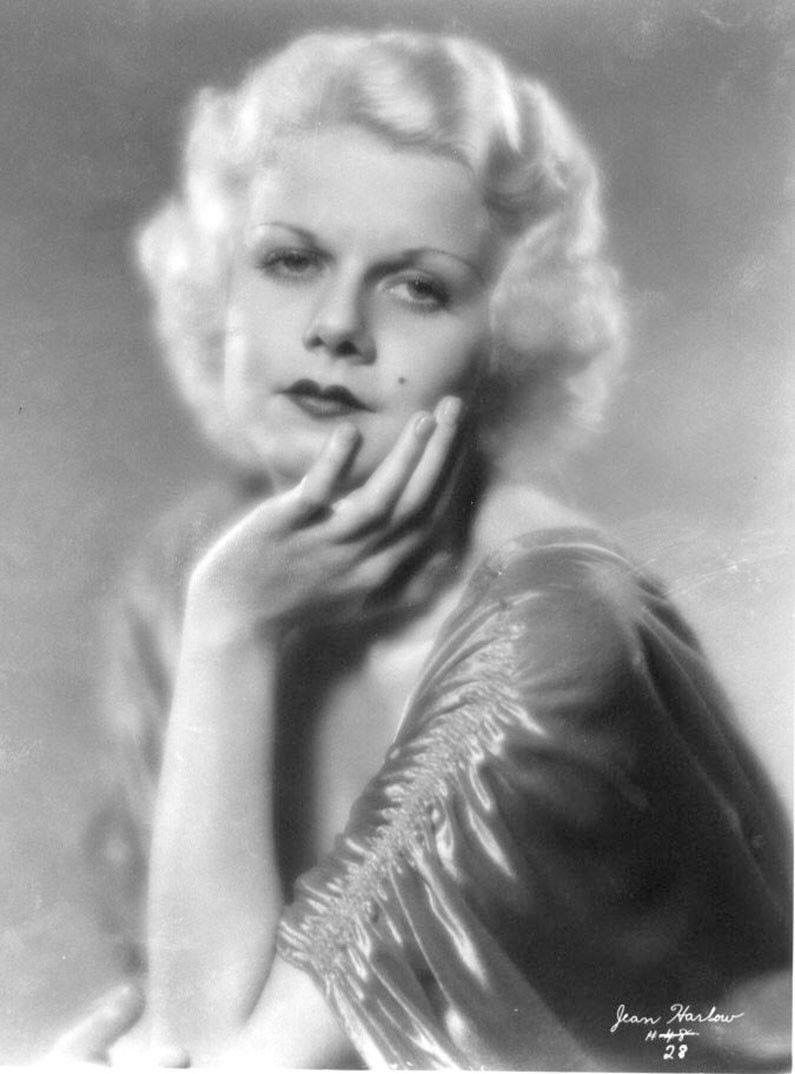
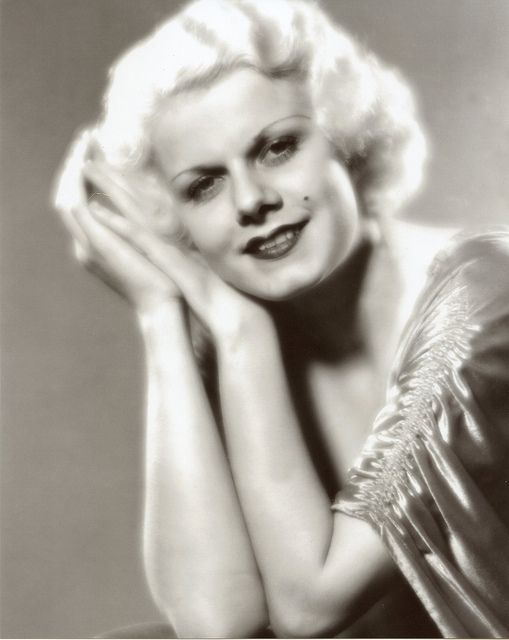
Clarke had played with Harlow in The Public Enemy mere months before and didn’t think much of her. “She was embarrassing in The Public Enemy,” she told Harlow biographer David Stenn, “And she was embarrassing in this film, too.” I don’t necessarily agree with her.
Sharing the honors with Mae Clarke and Jean Harlow is Marie Prevost, the third “wise girl”. Prevost does a marvelous job as Dot, Cassie’s roommate, and offers us some choice quotes, this one being my favorite:
“I was gonna throw this stuff out – but, you might as well eat it. Aw, there’s one of the finest little weenies that ever graced a paper plate. It’s a little shriveled from old age. But, of course, you can’t have everything. And the baloney – well, its just baloney.”
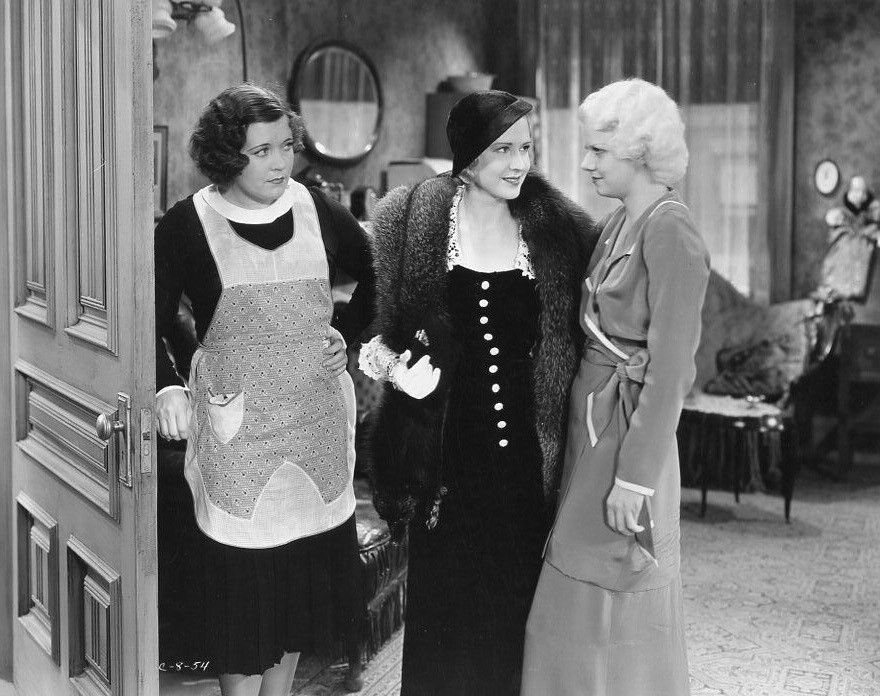
Prevost, a former bathing beauty and model, had recently been ridiculed in the papers for gaining weight. It didn’t matter to the public that she had seen her fair share of tragedy. She wrestled alcoholism and binge eating disorder as a result. Due to her change in appearance, Prevost was relegated to comic sidekick roles. She didn’t mind. “Aw, hell, that’s the way it is.” Prevost passed away only six years later.
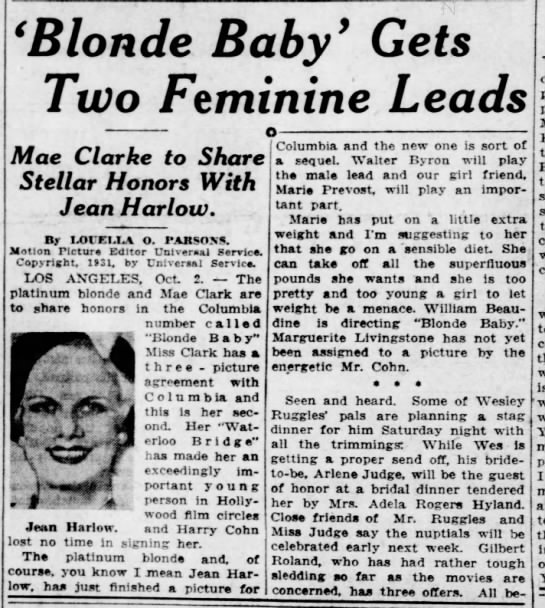
Mae Clarke, another star who had been up and coming, was not without her own share of difficulties. Clarke only made a handful of films after Three Wise Girls before suffering a nervous breakdown in June 1932. Her face was extensively scarred in a 1933 car accident, and her leading lady card was revoked as well. Clarke spent the rest of the decade playing sporadically in B films.
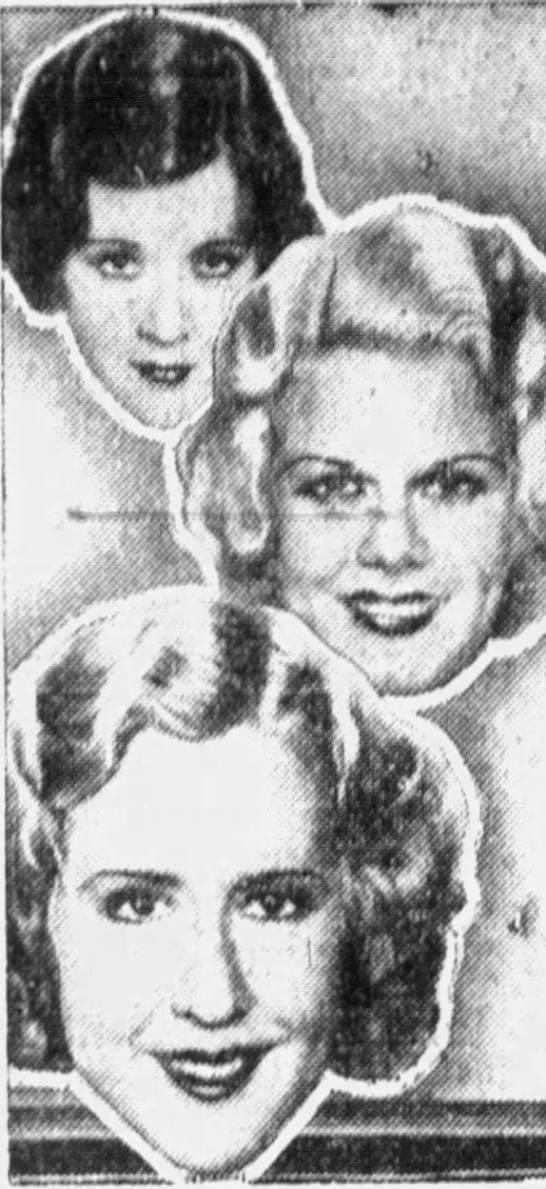
Ironically, as these two falling stars struggled, Harlow held her first top billing with Three Wise Girls. The film was released on January 11, 1932. A release date of February 9 is sometimes given, when Variety first published a review. Critics had noticed a slight improvement from her roles that spring, but were ambivalent on the picture as a whole.
“Jean Harlow has the lead – the girl who keeps straight. She does her best to suggest the innocent young thing and does better than might be expected. But she fails to be convincing and Mae Clarke takes the acting honors from her, even with her stilted speeches. Marie Prevost struggles gamely with the comedy. Natalie Moorhead has one brief scene, which adds another good name to the cast. Walter Byron carries himself nicely as the sincere lover, and Jameson Thomas keeps just this side of overacting the heavy.” – Variety, February 1932.
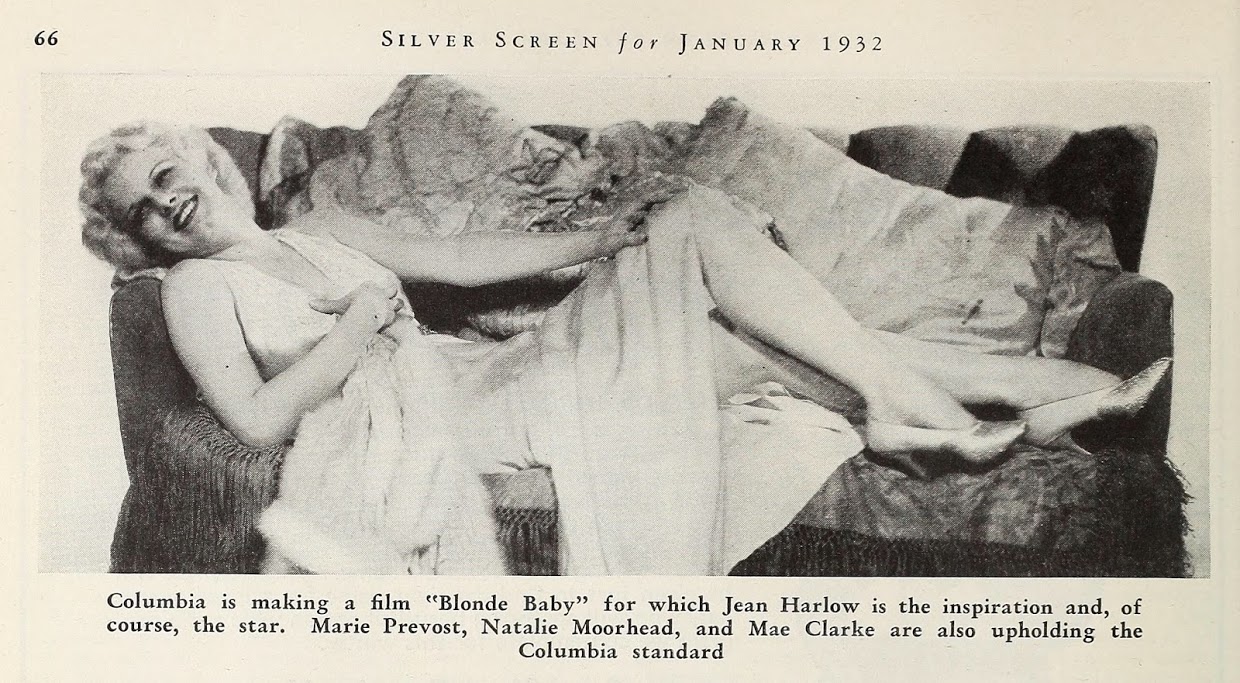
Despite the mixed reviews, Three Wise Girls did alright at the box office and gained Harlow some traction among viewers. The public was noticing the effort she put in.
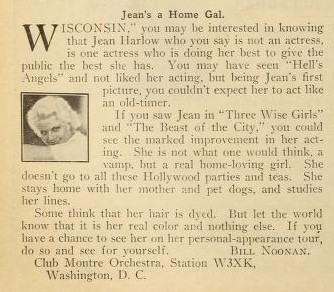
Three Wise Girls was a first step in Jean breaking out of wallpaper roles. It wasn’t perfect by any means, but laid some of the foundation for her future. A discrepancy between Hollywood producers and their public happened when Jean didn’t receive any offers after Three Wise Girls. It took yet again the assistance of Paul Bern to sign her for The Beast of the City in November 1931.
Another strong performance that bolstered her rising status, The Beast of the City takes credit for securing Jean’s MGM contract. Personally, Three Wise Girls was a much better film.
It’s remarkable that Red Headed Woman was her next film only six months later. Jean’s raw talent had always existed, but was discarded in favor of focusing on her outward appearance. It would take MGM’s guardianship to fully shape her ability. Lil Andrews of Red Headed Woman is still an unsympathetic vamp role, but it was much better quality. She didn’t have to rely on platinum hair, and her character was marvelously written by Anita Loos. Right afterward came the vivacious Vantine of Red Dust.
Three Wise Girls is now only a footnote for pre-code completists and Harlow fans, but has a grand reputation among its viewers. It portrays plenty of racy undressed scenes precious to 1930s film fans, and has morals. I always enjoy a good “working woman” picture; Jean’s characterization and retorts seem effortless. Clocking in at just over an hour, the film doesn’t lull; it’s succinct and thoroughly entertaining.
Three Wise Girls is a must-see if you’re interested in watching Jean perfect her craft. She did not sit idly after Hell’s Angels. She practiced diction and learned from watching her peers. If one watches this film after The Public Enemy they will notice marked improvement and direction.
On a closing note, here’s a fun fact; Director William Beaudine hired actual soda jerkers and had Jean practice on dispensers to look realistic. Within a few hours, she had it down, and wisecracked: “If pictures don’t work out for me, I have a job at any drug store!”
Sources
Ankerich, M. G. (2010). Dangerous curves atop Hollywood heels. BearManor Media.
Clarke, M., & Curtis, J. (1996). Featured player: An oral autobiography of Mae Clarke. London: Scarecrow Press.
Leiber, R. (1931, November). “I Cannot Write That Story — But I Can Unmask Jean Harlow!” Photoplay Magazine, 70, 71, 112-114.
Neibaur, J. L. (2019). The Jean Harlow films. Jefferson, NC: McFarland & Company.
Rooney, D., & Vieira, M. A. (2011). Harlow In Hollywood: The Blonde Bombshell in the Glamour Capital, 1928-1937. Angel City Press.
Stenn, D. (1993). Bombshell: The Life and Death of Jean Harlow(1st ed.). Doubleday.
Thomas, D. (1931, July/August). Queen of Flicker Blondes Done With “Bad Girl” Roles. Santa Cruz Evening News, p. 2.


I LOVE this film. This and Red Dust are the flicks that first made me a fan of Jean.
LikeLike